Amazon Is Letting the Prime Badge Leave Amazon: What Sellers Need to Know
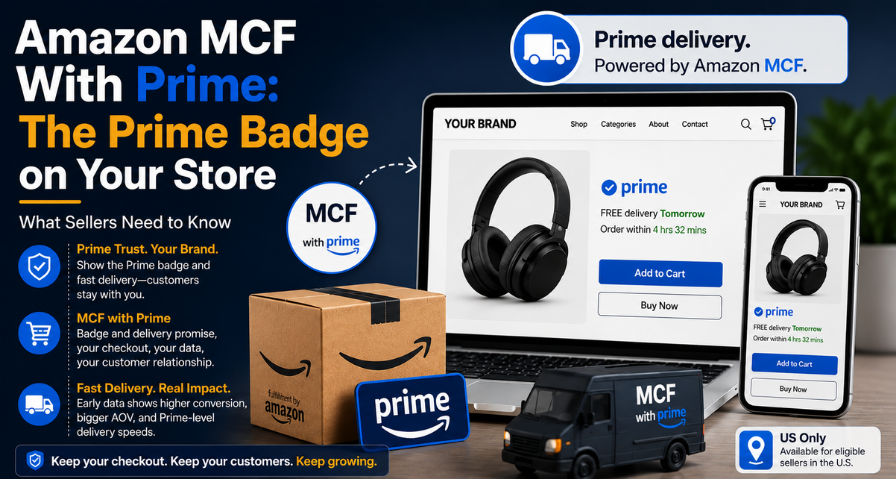
The Prime badge, over the past decade or so, has been the most convincing square foot of real estate within e-commerce. It is the two-day guarantee, the free-returns guarantee, and the unspoken handshake saying, Your money will be safe. Amazon has earned that trust over many years of operational excellence, and Amazon has protected that trust just as fiercely. That is why it is important to pause for a moment with the recent Amazon MCF with Prime rollout. Amazon is now giving eligible sellers who use MCF access to the Prime badge, as well as Prime delivery speed information on their own website, via their own check-out process, without ever directing the customer to Amazon.com. If you use MCF, then it is worth seeing if there is anything waiting for you either in your inbox or Seller Central.
What MCF With Prime Actually Does
The mechanics are simpler than most sellers expect, and that simplicity is the point. When a customer lands on your site and orders a product that is fulfilled through MCF, they see the Prime badge and an accurate delivery estimate, often a day or two, right there on the product page and at checkout. There is no login prompt, no redirect, and no Amazon account required. The customer completes the purchase entirely within your store. You keep the cart. You keep the customer data. You keep the relationship. Amazon just becomes the invisible force propelling the box where you want it to be delivered, which is essentially what Amazon has been doing for MCF sellers for quite some time now, but the difference is that your shopper can see Amazon's reputation for speedy delivery right at the moment when he/she decides to trust you.
It is very important to be precise regarding the terminology since everything becomes more clear when we distinguish between two similar concepts. The first concept is the Prime badge the trust signal. This trust signal is presented through a small logo familiar to consumers in connection with fast and reliable delivery. The second concept is the Prime delivery the fulfillment promise. This fulfillment promise guarantees that the order will be delivered to a consumer within one or two days after he/she makes an order. The Amazon MCF Prime delivery offers both features on its separate website.
Why This Is Not Buy With Prime
This is the distinction most sellers are going to get wrong in the first few weeks, and it matters enormously. Buy with Prime, the program Amazon launched a few years ago, requires the shopper to log into their Amazon account during checkout on your site. Amazon effectively inserts itself into the transaction flow. It processes the payment, it owns a piece of the checkout experience, and it sits between you and the customer in a way that changes the nature of that relationship.
MCF with Prime is badge-only. Nothing about your checkout changes. The customer never authenticates with Amazon, never sees an Amazon-branded payment flow, and never leaves your domain. What Amazon is offering here is narrower and, for a lot of sellers, more useful: the trust signal without the checkout takeover. You are borrowing Amazon's reputation for reliable, fast delivery without handing over any part of the purchase funnel. For brands that have spent years building direct customer relationships and collecting first-party data, that difference is not a technicality. It is the entire reason to consider this program at all.
The Pricing Window and What to Verify Before You Rely on It
Under the new Early Access Program of Amazon, it has been made clear that sellers who can avail this offer will get to offer the facility of Prime delivery for the first year without having to pay anything additional for it. It has been said that after the completion of the first year of participation in this program, the costs become close to what is usually charged for the three-day MCF delivery, suggesting that apart from normal fulfillment costs, there is no extra cost associated with this program. However, the point that needs to be noted is that Amazon changes fulfillment costs often.
Nevertheless, timing is still the problem that needs to be considered regardless of this note. Firstly, the cost of MCF is quite expensive in comparison to the FBA, and the peak price policy is implemented once per year at the end of fall. The cost of regular single unit is equal to $7.34 and does not include the peak price, while the cost of regular large item weighing from one to two pounds is equal to $10.64. In terms of Amazon’s official documents, the date of October 15 is specified as the beginning of the peak prices, but sellers need to find out the current date according to the latest Amazon documentation because of the changing fulfillment calendar. The only sure thing is that it is more beneficial to implement the promotion period before the peak prices because of the high activity level of these months.
Does the Badge Actually Move Sales
The difficulty in identifying trust cues is that while they are easy to generate, they are difficult to prove. And the issue here is whether this has any impact on the buying pattern of consumers. The early signs indicate that this could well have an effect, but then with plenty of caveats. One example is of the company JLab, which offers audio accessories. It enabled Amazon delivery badges on its website and found a 55% improvement in site conversions in the first month and a 37% increase in order values for Prime badge orders. Average delivery time landed around 1.5 days, against a category average closer to five. Amazon's earlier company-wide figure for Buy with Prime, a separate program with a different mechanism, put the average conversion lift at 25 percent. These numbers come from companies with an obvious interest in promoting them, so they deserve the usual skepticism reserved for any vendor-supplied statistic. But the direction across every data point, toward higher conversion and higher order value when prime-level trust is visible on an independent site, is at least consistent enough that sellers shouldn't dismiss it out of hand.
The Math That Actually Decides Whether to Switch
This is when things really come down to brass tacks, when the buzz surrounding the program has to meet up with a spreadsheet. MCF costs more than FBA and usually more than a decent 3PL setup, and the difference grows as the goods get heavier. If your existing 3PL ships an order at $5.50, MCF will do the same for $10.64. This represents an extra $5.14 per order fulfilled. The only way it’s worth that much extra in fulfillment cost is if the Prime label generates enough additional contribution margin per order won to make up the difference, and that is very business-dependent. Hence, it's worth calculating your own number, not some percentage you heard from someone else.
As a general approach, divide the extra per-order fulfillment cost by your actual contribution margin per order to see how much of a conversion lift you would need just to break even, and then compare that to a conservative estimate well below the vendor case studies before committing volume to the switch. JLab's reported results suggest the badge cleared its own break-even threshold with room to spare, which is why the case study reads so well. But JLab sells relatively light, relatively high-margin audio accessories. A heavier product with thinner margins might land in very different territory, no matter how much the badge improves trust. Model the threshold using your own margin, traffic, and fulfillment costs before moving inventory into MCF for this purpose.
Three Operational Risks Worth Watching
Inventory planning is the first one. Since MCF can use inventory held within Amazon’s fulfillment centers, there can be various combinations of what your stock used to fill your orders through Amazon listings and stock used to fill your orders outside of Amazon depending on how you configure your account and inventory. In other words, this means that a high volume of orders coming from your direct-to-consumer channel during promotions or holiday season can impact the inventory that your Amazon storefront has if it is not planned in conjunction with the other channel. A stock-out event during peak season will cost you not only sales but also negatively impact your listing’s search results and eligibility for the Buy Box. When you start working in this channel, you should purchase buffer inventory intentionally for both channels, not thinking that Amazon will somehow balance the load.
The second aspect relates to the price window. It offers a very generous free period, which is, however, limited by time. Peak prices will occur during mid-October this year, depending on what the latest Amazon documentation shows. For sellers who choose to join the promotion now, the benefit will be greater, as they will have more time during the holiday season within the free window than sellers who join next year.
Third, there is packaging. The good news for MCF users is that unbranded, blank-box fulfillment is supported by MCF. The not-so-good news is that this doesn’t mean that unbranded, blank boxes will automatically be used. If someone purchases from your DTC brand and receives a smiling Amazon-branded box, then he or she is sure to take notice. Before shipping out any products through this service, make sure that you have enabled unbranded packaging.
What This Means Going Forward
Over the years, Prime has served as the competitive edge that Amazon had over independent e-commerce, an element of trust that could not be easily duplicated by an inferior brand regardless of how great their product and customer service may have been. By allowing Prime access to those who are selling via the MCF channel, Amazon has essentially taken the same kind of signal and extended it, at least for those qualified merchants during this promotional period, to any brand that happens to be within their fulfillment network. This is actually quite a substantial step for a company that has never been too forthcoming about its capabilities, and it makes sense to look at why this is being done. The main reason for this is simple it doesn’t really matter which option the customer chooses, as Amazon wins both ways.
The potential is genuine, but there are strings attached. Brands that can afford the cost premium associated with MCF on an order-by-order basis, the weight profile that keeps it manageable, and the discipline required to coordinate inventory between channels are rewarded. This isn’t a potential that is realized by brands who join MCF on impulse based on someone else's case study. Get verified within Seller Central for eligibility and terms, calculate your own breakeven point based on the lift in conversions, double-check that you have the packaging settings correct, and make sure you know where the next peak price goes into effect before you commit. Assuming it works out on paper, there’s an argument for getting on MCF with Prime before the peak price starts rather than after. The Prime logo that was exclusive to Amazon in the past may be something you qualify to take with you. Whether that’s worthwhile depends on what it will cost you to do so.
Ready to Grow on Amazon?
Let our experts help you scale your Amazon business with proven strategies.
Get a Free Consultation