Amazon FBM Materially Different Returns: How to Document, Dispute, and Protect Your Inventory
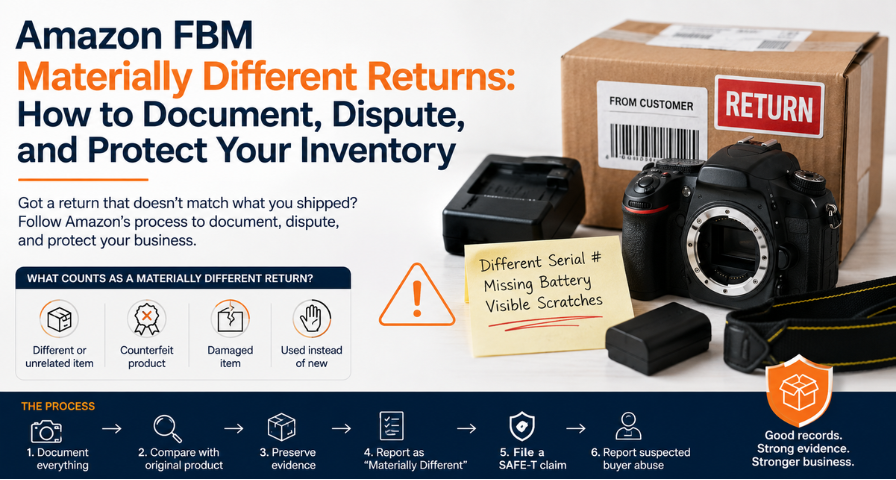
Being an Amazon merchant that ships his products through the FBM program, you definitely know that return is a part of your routine. It is not unusual for the customer to change his mind, order the wrong size, or just decide that he does not like the product. But sometimes there appear items returned to your warehouse that make you raise your eyebrows. They are lighter, have strange numbers, do not correspond to your items or even seem to be used and worn.
Amazon's guidance addresses these situations as materially different returns, and the company has laid out a clear process to help FBM sellers handle them correctly. Understanding how Amazon approaches these cases can help FBM sellers protect their inventory, revenue, and account health. In this article, we'll break down what a materially different return actually is, why this guidance matters for FBM sellers, and exactly what steps to take when you suspect one has landed on your doorstep.
What Counts as a Materially Different Return
A materially different return is a case in which the item that was received by the customer is materially different than the item that the seller originally sent out. This could take several forms, including a product or model that is different, a counterfeit product, a product that is unrelated to the product that was ordered, or a case in which the returned item is in a different state, like a new product being exchanged for an old or damaged one. It is important to point out that this is not every case where a customer opens a package or returns something in a different state, because there must be a material difference between what the seller sent and what was returned to him.
As far as the FBM program is concerned, the difference here is that Amazon does not manage the process of return physically as it does in FBA, and the seller has more control.
Why This Guidance Matters to FBM Sellers
Return fraud and return abuse are a recognized challenge across e-commerce, and it's reasonable to assume this is part of the backdrop for why Amazon has clarified its guidance in this area. Regardless of the exact reasoning behind it, what matters most for sellers is the practical effect: Amazon is giving FBM sellers a defined process for documenting and disputing returns that don't match the original shipment.
For sellers, the important shift is not simply new terminology. It's having a clearer framework for documenting a discrepancy, classifying it correctly, and pursuing reimbursement or abuse reporting through the appropriate channel. Knowing this process exists, and using it consistently, is what separates sellers who absorb repeated losses from those who successfully recover them.
The First Step: Document Everything Immediately
The very instant you get a questionable return, resist the temptation of either simply discarding it or proceeding with processing the package the same way as usual returns. First and foremost, take pictures of everything connected with the return: of the shipping box, the label, the product, and any serial numbers or models you may see on it. This will become your key evidence in case you need to dispute this return.
It might be helpful for you to consider this step as an insurance adjuster would do when dealing with a certain claim. Thus, you are going to create your factual report which doesn't depend on memory or assumptions. Make sure to take as many pictures as possible from various angles, capturing any signs of the damages you have seen. Don't forget to picture the packaging materials as well, because they might provide important clues. The more evidence you manage to collect about the questionable return, the higher are your chances of disputing it successfully, although it should be noted that having lots of documentation doesn't guarantee any result.
Comparing the Returned Item to Your Original Product
Now that you have taken note of your return, the next step involves comparing your findings with the product description and the original package information. In order to do so effectively, you should consider having a well-kept record of the original outgoing shipment, which will make your job easier. If you manage to prove that the serial number does not match, there are accessories missing, or the item shows signs of prior usage and is not in its original condition, then it would be considered materially different.
It should be noted that such a comparison method should be used by sellers only if they have a system for recording outgoing shipments. It will put them in a good position to argue their side in any possible dispute. Otherwise, they would simply have no evidence apart from their own word, which is not enough.
A Practical Example
Take, for example, an FBM seller who shipped out a camera priced at $600 along with its serial number, one battery, charger, and original packaging. The buyer then sends back another camera with a different serial number, some scratches on it, and without a battery attached. The seller takes photos of the return shipment, shipping label, the actual camera returned, serial number discrepancy, and lack of accessories.
With this information, the seller then verifies that the return is actually fraudulent by matching the data with their shipping data and verifying the discrepancy. With this done, the seller puts the camera to the side but does not throw anything away, marks the return appropriately in Seller Central, and, where possible, submits the SAFE-T claim.
This type of procedure from start to finish provides the best opportunity for dispute success.
Preserving Evidence Until the Case Is Closed
Although it will be very tempting to clean up the inventory that has been returned, it is not recommended that you throw away either the package or the product before the entire situation has been sorted out. Amazon may need further information in order to solve the dispute, and having the actual item in possession will go a long way towards helping you win the case. Keep the returned item separate from the other items.
Reporting the Return Correctly
In case you are sure that there is material difference in the return, you should indicate “Materially Different” at the time you initiate a return using Seller Central. This is very important because it will be useful in categorizing your case in the Amazon system for any future dispute. In case you fail to do so, it will become tough for you to claim the refund in future.
Filing a SAFE-T Claim
Qualifying FBM sellers have the opportunity to file a SAFE-T claim to contest some of their losses related to returns based on the conditions set forth by Amazon. According to the guidelines, one is expected to submit a SAFE-T claim within 30 days following the return. However, sellers must always check whether there are any recent changes to policy in Seller Central because those may vary from time to time. You will need to base your SAFE-T claim on all of the information you collected: pictures, serial number comparisons, and all other supporting documents.
Reporting Suspected Buyer Abuse
The key difference is that a mistake made by accident is not the same as misusing the return policy to one's own advantage. In case there are reasons to assume that the customer intentionally returned a wrong product in order to abuse the system and receive a refund, then the best way to take care of the situation is to use the Report Abuse tool in Account Health and provide evidence for the abuse.
Protecting Yourself Before You Even Ship
Of all the suggestions contained within this advice, the most beneficial one tends to be preventative rather than reactionary in nature. When shipping products that either cost a lot of money or have the possibility of being easily replaced, document as much information about the serial numbers, state of the product, packaging, and any accompanying accessories as possible. It may seem a bit excessive for a normal transaction, but in the event of any problems occurring, it will prove invaluable to have this documentation.
Bringing It All Together
Materially different returns are an unfortunate but manageable part of running an FBM business on Amazon. The key is treating every suspicious return as a potential case from the very first moment, rather than realizing too late that you should have taken photos or kept the packaging. Document thoroughly, compare carefully, classify accurately, and use the tools Amazon provides, SAFE-T claims and abuse reporting, when the evidence supports it.
For sellers, this guidance is really a reminder that good record-keeping isn't just administrative overhead, it's a form of protection. Sellers who treat documentation as a standard part of their process, not an afterthought, are the ones who recover losses more consistently and keep their accounts in good standing. Take a moment this week to review your own returns handling process. If serial number tracking, condition photos, or packing documentation aren't already part of your routine, now is a good time to build them in, before you need them.
Ready to Grow on Amazon?
Let our experts help you scale your Amazon business with proven strategies.
Get a Free Consultation