Amazon FBA Fees 2027: Recalculate Your Product Economics Before the New Rates Arrive
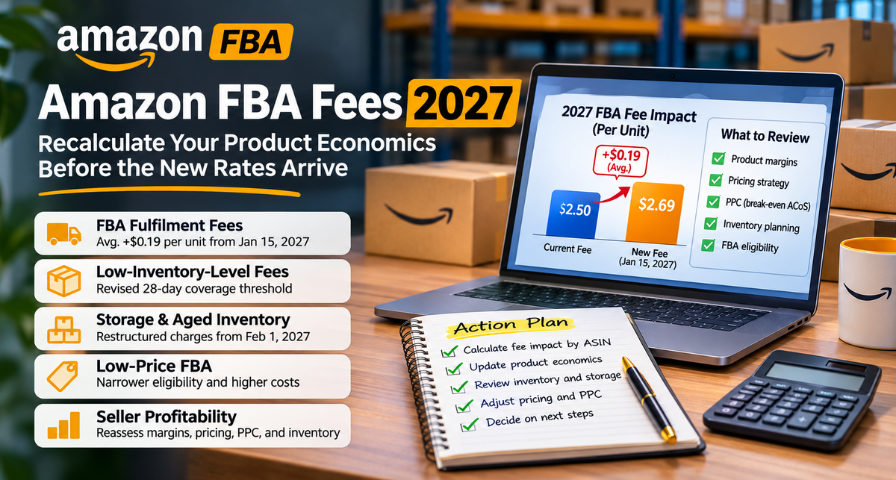
The majority of merchants scan an announcement of fees in the same manner as they scan a software update, looking for the one number that counts and getting back to their work. This announcement of Amazon 2027 FBA fee changes requires a thorough reading because the changes are much deeper than just one new fee. There is one number mentioned in the title of the announcement, which seems to be small enough. But the underlying system used to calculate all your costs per fulfilled order, storage per unit, and shortages is completely different now.
The Headline Number and Why It Misleads
As far as Amazon fulfillment fees in 2027 go, the first number anyone notices is the increase of $0.19 per unit sold, starting on January 15, 2027, which Amazon estimates to be about 0.8% of the average unit price of a product. This is a minuscule number, precisely because it is just that, a tiny number. Average means something non-existent.
As Amazon stated, the increase will be different for every product depending on its size and price, but in general, each fee should reflect the true cost of fulfilling a particular product better. Comparisons done by third parties at the early stage show how varied the increase will be. One published comparison states the increase of small standard-size products with the price above $50 by $0.70 per unit and large standard-size products with the price from $10 to $50 by $0.12 per unit. These numbers should be considered as segment averages and verified using your Seller Central rates.
This is the importance of the differentiation between the two. A merchant selling 500 units of the first product per month will incur additional monthly costs of $350, which amount to $4,200 per year. A merchant who sells 2,000 units of the second product per month incurs additional monthly costs of $240, which amounts to $2,880 per year, even though the price increase per unit is much smaller. Volume may make a small charge large, and high charges may be manageable for low-volume sellers.
How the New Fulfillment Charges Fit Together
The new rate card kicks in starting on January 15, 2027, which is right after the expiration of peak fees. The peak fee period will be from October 15, 2026, through January 14, 2027; thus, it means that January alone will not bring you back to where you were paying prior to the holidays.
Over the base fee goes the fuel and logistics surcharge. In April, Amazon announced an additional 3.5% surcharge for the fulfillment fees in the USA and Canada. As was stated when covering that, the surcharge had no specified ending date. The best strategy is to factor in the surcharge into your calculations for the entire year 2027, treat peak fees as a seasonal one which disappears by mid-January, and monitor further developments from Amazon.
Bulky and Oversize Products Face a New System
Should you wish to ship anything that is larger than standard size, then this becomes a redesign, not an upgrade. According to another review, bulky will be split into four, and four weight-based extra-large tiers into six oversize tiers, mainly dependent on length. The overmax handling fee is abolished, and two other handling fees come to replace it. Another list of the new fee scheme splits bulky into small, medium, large, and extra-large bulky tiers, with oversize going from small to special oversize. The two replacements for the old fee are a flat product handling fee and an overhang handling fee. But do make sure to consult Amazon’s guidelines before constructing your own 2027 rate chart, since the specific tiers and fees can be easy to report erroneously.
As usual, the impact is mixed. As illustrated by two examples below, the 65-inch TV box is expected to go down to $48.57 from $36.55, while the 97-inch bulletin board will jump from $50.93 to $69.75.
This is why the importance of packaged dimensions cannot be understated. Pricing tiers are based not only on the dimensions of the product but also on its weight after being boxed. Two products that weigh approximately the same may fall into two separate tiers if one of them has larger dimensions than the other. Look at the dimensions you have saved for your listings; an overly optimistic number may put your product into the wrong tier.
Low-Price FBA: Run the Numbers Before You React
Eligibility for Amazon Low-Price FBA is becoming increasingly stringent under the new system. According to one study, the new schedule is made up of five categories that will no longer have the benefit of the low-price rates. Make sure that none of the items in your portfolio belong to an eligible category.
For the purpose of illustration, let us take a product that sells at $9.99, using figures other than the ones offered by Amazon. Referral fees are 15 percent or $1.50, while the cost of goods sold is $3.00. Advertising is about $1.50 per unit sold, and the fulfillment fee is $2.50 per unit. There remains about $1.49 of contribution margin per unit after these costs. If the rate of this product changes to $3.20, the contribution margin goes down to approximately $0.79, a reduction of half, due to only a $0.70 change in the rate. Demand and advertising remain the same, but the value of the product to the business has been greatly reduced.
The answer varies depending on the item in question. Bundling may increase order values enough to distribute the fulfillment costs to a larger revenue pool. Smaller pricing tests could cover some of the added costs. Some product lines may no longer be eligible for FBA. Do not assume that increasing your prices will make the product line eligible or profitable, as the eligibility is governed by Amazon’s program guidelines. For any product line where you will consider bundling, start by looking into the bundle policy, as there are reports of the January bundle rule causing account health violations.
The Low-Inventory-Level Fee and the 28-Day Test
The 28-day benchmark itself is not new, but the testing mechanism used by Amazon certainly is. In the seller announcement, Amazon noted that currently, the fee applies based on the trailing 30-day and 90-day sales, but as of February 1, the fee will apply whenever the inventory drops to the level below the 28-day supply benchmark in terms of actual shipments in the four weeks prior to and following the assessment. In Amazon’s view, considering the four weeks after the assessment helps determine if the low inventory was caused by real demand and thereby will lower the number of fees imposed due to seasonal surges or discontinued products.
This is certainly a fairer standard for most sellers, but it definitely changes your plan. As Amazon will require four weeks worth of information in addition to the four weeks before the inventory assessment, the fee is charged four weeks later. A true stockout on a consistent seller will still be detected, but a clearance on an obsolete product will result in fewer fees.
Below is an illustration of planning, not the official Amazon fee calculation procedure. If a product ships 20 pieces per day and your inventory level is 400 pieces, this means 20 days of safety stock, falling below the 28-day line. In addition, let us assume there is a supplier delivery lead time of 45 days. In order to remain protected, you must be ready to order at the moment you have enough inventory to account for the lead time plus a 28-day buffer, making it 73 days of safety stock, or 1,460 units. For cross-border sellers, this reorder level must be adjusted to include transportation times, customs clearance, and Amazon inbound fulfillment process delays. From February 1, 2027, you can access a Low-Inventory-Level Fee Report with order-level detail, trailing/following days of supply, and exception reasoning.
Storage and Aged Inventory After February 1
Storage changes are to happen in February 1 as well. Amazon will stop charging the utilization surcharge. It will get rid of the aged inventory charge and roll it into monthly storage charges based on age. The logic of Amazon is that eliminating the utilization surcharge will help sellers prepare for high demand times. Items sold in less than six months incur fixed or reduced fees, whereas items older than six months incur higher fees.
Let us take two sellers with 1,000 units of inventory in hand. Seller one sells 800 of them in three months and has 200 left as aged inventory in the warehouse. Seller two sells 200 and has 800 units of aged inventory. Both start out with the same investment but with very different storage risks and tied capital each month.
The sell-through ratio and inventory aging need to be included in your monthly financial reviews and not as a quarterly clean-up exercise. When it comes to aged inventory, look at the costs associated with holding each unit versus the amount that can be recovered through discounting or removal. It is possible that removal may be costly when discounted sales will only take one quarter. On other instances, removal may not be justified since the item sells at full price.
What the Changes Do to Your Amazon FBA Profit Margin
Here are three concepts that blend together and require some clarification. The contribution margin is the net profit left after covering product, fulfillment, referral, advertising, and other variable expenses. The break-even ACoS is the maximum possible advertising expense, expressed as a percentage of attributed sales, above which the contribution from sales becomes negative. TACoS is a ratio of advertising to all sales, both organic and paid, which demonstrates the extent to which a product depends on paid traffic.
Here is how they look when applied, based on the assumptions provided. Consider a product worth $29.99, with the contribution from each sale before advertising being $12.00, or roughly 40% of the sale price. Let us assume the increase in the fulfillment fee of $0.40. Selling price and all other expenses remain unchanged, making the contribution before advertising $11.60 while the break-even ACoS decreases from 40.0% to roughly 38.7%. A promotion with an ACoS of 25.0% will look very healthy on the dashboard, but the product makes smaller profits from each sale, while the room for aggressive bidding becomes smaller. At 1,500 units sold per month, the additional $0.40 equals to $600 in fulfillment expenses per month.
The right response depends on the product. A seller with strong organic share and conversion may test a small price increase. One who depends heavily on ads may need to tighten targeting or trim bids. Someone with leverage over a supplier might renegotiate unit cost. Also review inventory and advertising together, since running low on stock while continuing to fund traffic is one of the most expensive habits in Amazon advertising.
A Practical Product-Level Fee Audit
Let’s start by mapping out the rate card to all the active SKUs, and not just the top-sellers. For each SKU, calculate how much did the fulfillment cost increase since January 15th, compare the packaging size and shipping weight to identify the applicable fulfillment level, and calculate the contribution margin with the referral fee, extra fee, storage cost, and advertising taken into account.
Then, you have to split all the SKUs into 3 categories: those that have the margins preserved in a decent shape, but still need to be monitored; those that suffer from margin erosion and need an analysis of price, distribution, and effectiveness of advertising; and the SKUs that turned out to be unprofitable and need to be bundled, changed in terms of fulfillment, liquidated, or discontinued. You also have to set guardrails for inventory (how many days of supply vs. actual lead time), and for advertising (a new break-even ACoS).
Preparing for 2027
A proper perspective of the update is the reallocation of cost rather than an increment in one go. The $0.19 average doesn’t provide any visibility on winners and losers, the surcharge stays in place, LPFBA is getting tighter, the size tiering is being reset, and the storage and low inventory fees are now based on how fast your inventory turns over. Before the implementation of new fees, each seller needs to identify the ASINs that will be able to bear higher cost, ASINs that require changes in operation, and ASINs that don’t generate profitable margin anymore. For 2027, making money on Amazon will require more than just boosting sales.
I wonder, have you evaluated your 2027 fulfillment cost per ASIN yet? If yes, then I am interested to know what ASINs have shocked you the most.
Ready to Grow on Amazon?
Let our experts help you scale your Amazon business with proven strategies.
Get a Free Consultation
Comments (0)
Leave a Comment