Amazon Fake Negative Reviews: How Competitor Attacks Damage Brand Reputation and What Sellers Can Do
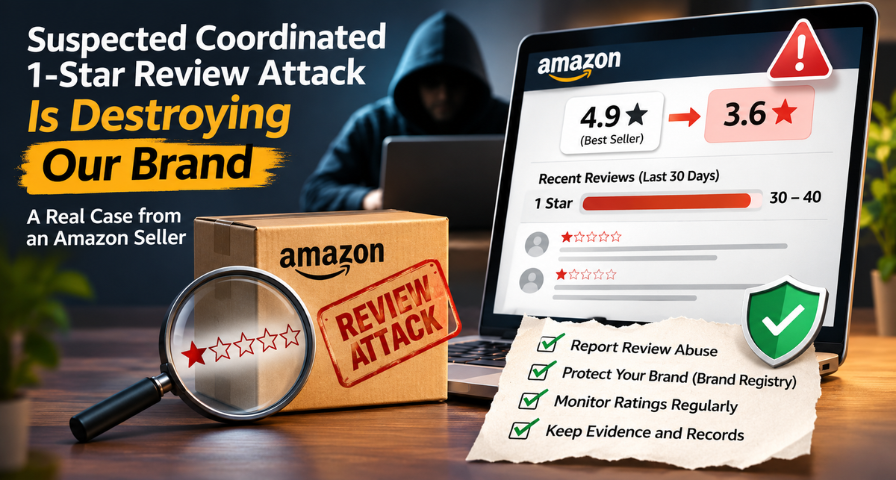
Competitors are usually perceived as adversaries when it comes to price wars, quality of products or services, and promotional activities. But what about an under-the-radar strategy to damage your reputation? One brand owner revealed such a story in his latest seller report. The best-selling item received 30-40 one-star reviews in just one month. The rating dropped from 4.9 to 3.6. And with it, sales plummeted.
For owners of private label brands in competitive niches, this story might be relevant. It is proof that the reputation, conversion rates, and profitability of the ads are interconnected. In other words, the damage to one of these factors will inevitably affect the other two. The following article describes how negative Amazon reviews for a particular brand can harm it, how to distinguish Amazon review manipulation from true complaints, what tools can be used, and how to recover.
What Actually Happened in This Case
The seller did not refer to pure coincidence and misfortune. Instead, they made a point of the timing. Before a barrage of one-star reviews came, the seller reported their competitors for using their trademark, packaging, and product photos. For them, this was nothing but retaliation and an effort to drive the seller’s product off the market.
Choice of words is essential here. The seller assumes that there was some kind of organized campaign, which means that assumption is not evidence. In most cases, Amazon does not disclose to sellers who initiated a bunch of reviews, and reasons for a drop in the rating might be quite innocent, like an occasional defect, packaging alteration, or incorrect listing. However, the scenario is common for competitor attacks on Amazon it starts with a good product and continues with a series of negative reviews and a conflict with the competition.
Why a Few Dozen Reviews Can Do So Much Damage
For example, assume there are 400 reviews with an average of 4.9. Then adding 35 one-star ratings will result in an average of around 4.6. It is unpleasant but not in the way that it results in 3.6. Using the simple mathematics, the decrease to 3.6 implies a very small number of total reviews, possibly around 70-80. It should not be taken literally, as Amazon rating is not calculated simply as an average of all the ratings and takes into account other factors like recency and verified purchase. However, the main idea is valid the lower the number of reviews in the list, the more sensitive it is to any change.
The psychological effect of the average is even bigger. There is no doubt that most consumers treat any rating below four as a red flag. Also, some of them filter their search by ratings. It does not mean that the listing becomes automatically invisible for these consumers because there is no general principle like this, but it usually impacts the conversion rates significantly. As the orders decrease, so does the flow of the fresh positive ratings.
The Hidden Financial Cost of Negative Review Attacks
It is not just about vanity. Rating impacts the following business metrics: conversion rate, advertising efficiency, organic growth, profit margin, and even inventory turnover because low sales make the items stay in storage for a longer period.
Let us look at an illustrative example rather than actual data provided by the seller in his report. Prior to the fall of the rating, the product receives $500 worth of ads and brings in $2,000 in attributed revenue, with an ACOS equal to 25 percent. After the fall of rating, the same investment in ads provides $1,200 in attributed revenue, meaning the number of conversions decreased. ACOS is around 41.7 percent. There is no change in the advertisement strategy, but the cost per dollar invested became significantly lower. That difference makes the difference between profitability and losses for products with low profit margins.
Can Competitors Leave Fake Negative Reviews on Amazon?
Review manipulation is against the Amazon policy guidelines. This includes fake reviews, incentivized reviews, and abusive reviews. However, having such a guideline does not necessarily mean that all the questionable reviews are part of a competitor’s strategy. Confused customers, problems in the product itself, and buying the wrong product are examples of other factors that may influence the customer to write bad reviews.
Warning Signs of Fake Amazon Reviews
Sabotage is typically subtle. Often it will appear as just another frustrated customer, which is how it can be effective. The attackers might employ fake accounts made just for the job, complain about something being "not working," or declare that the item was received used, fake, or not in the pictures.
Actual customer complaints will come slowly and in clumps, tied to identifiable problems such as sizing, faulty parts, or shipping. Coordinated sabotage is going to come in waves, sometimes in under a few hours, with the same kind of wording and complaints that do not correlate with your return policy. Accounts with no prior history of purchases or rating all unrelated items one-star are red flags.
None of this proves anything, of course. Wording too similar could be because of an actual common problem, and grouped reviews could stem from a problem in shipment. But these are all things worth investigating. Sabotage does not tend to operate alone, often accompanied by listing hijacking, false complaints, stolen pictures, and counterfeit products.
Using Amazon’s Review Tools and Understanding Their Limits
Customer reviews from Seller Central become the obvious place to start looking at what happens on a regular basis. Use it to track fluctuations in star ratings and recently posted bad reviews and complaints about the same issue with the product. Make sure to complement this with data on your returns and refunds as well as conversion rates, as true problems with the product usually appear in all these categories, while invented ones don’t. It should be understood that the dashboard and reporting tools accessible to you depend on your eligibility and marketplace.
Report Abuse allows you to notify Amazon about particular reviews that, in your opinion, break Amazon’s review policy. The quality of such reporting is very important. Amazon won’t take down the review because it is negative or because it impacts your numbers negatively. A scathing but honest review stays on. Reviews can be taken down if they violate the policy of the platform, for example, if they are fake, incentivized, or abusive. This is the reason why having concrete information regarding the violations is more useful than just saying the review is unjust.
Keep both systems separate. Reviews for the products and seller feedback are two different systems used for two different reasons and have different methods of reporting. One star review of your product is not at all equivalent to the seller feedback for delivery.
How to Investigate a Sudden Rating Decline
Do not rush to conclude anything regarding attacks but rather follow the investigation process step by step. Consider the case study example where a rating fell from 4.9 to 3.6 due to around 35 negative reviews in 30 days. To begin with, it is necessary to check the dates of the release of the reviews and look for any abnormal groups of reviews.
The next stage consists of looking at whether there are similarities in wording or problems discussed in those reviews and whether these complaints correspond to your data. Pay attention to any trends in returns or refunds, any changes in production/package process, batches, fulfillment centers related to the reviews. The moment when the content of the review does not match your data in any way is what shows that the situation is rather suspicious. In case there is any problem in your data anyway, it is your problem that should be solved even without other considerations. You have your own baseline too. When your baseline is two or three negative reviews per month, 35 become suspicious.
Can Amazon Remove Fake Negative Reviews?
It will if they violate their policies, and constructive criticism is usually protected. You should highlight the violations in the policy that you have noticed. Take screenshots, including reviewer names, dates of writing, stars, and verification of purchases. Mention your numbers of ratings and sales before and after the spike. Note all related events, such as the date of your report of your competitors' infringements, as time provides reviewers with the necessary information.
Go official then. Report each review individually through Report Abuse and file the Seller Support case explaining the pattern of the behavior. Be objective and polite. A systematic report with the information about dates, volumes, and similarities is better than the attack against the competitor by name, as Amazon will not take any action against them unless you provide the proof of the behavior. Avoid reviewing yourself and threatening your buyers for five stars, as this is also a violation of the rules.
Amazon Brand Protection and Your Evidence Library
Reputation management and enforcement of intellectual property rights have something in common. By defending their trademark and listing description, a seller interferes with the interests of a party earning on imitation. This can result in counter-attacks; however, one should be ready for anything, not prevent it.
Amazon Brand Registry helps registered brands in filing reports of infringement, but let us make it clear once again: reporting tools provided by Brand Registry and processes of submitting reports regarding reviews are different, and Brand Registry enrollment does not necessarily mean protection from manipulations with reviews. What it means is protection against copying. Create a separate library of evidence that will not be linked to any marketplace account and will include such documents as your trademark registration certificate, photos of your products and packaging, and other materials related to your brand. The moment you need to show that somebody copies your images or packaging, you will save several days. Monitor competitors' listings for products similar to yours because a customer receiving a counterfeit product may leave a negative review on your listing.
How Can Sellers Protect and Recover Their Amazon Ratings?
Recovery will depend on your current state, and each scenario requires a different solution.
If suspicious reviews are coming in at all, the first steps to take are documentation, reporting, and monitoring and not making unsubstantiated accusations. If the reviews are no longer coming in, but your rating is still low, concentrate on satisfying customers, improving products, and making legitimate requests for reviews via Amazon's methods, thus enabling the good reviews to slowly undo the harm done. If sales and ads have been negatively affected, examine your conversion rates, search term performance, ACOS, organic sales, pricing, and stock levels prior to budgeting or bidding adjustments.
This needs reiterating increasing your bids in an effort to recover the sales lost is quite natural, but if your conversion rate is poor, your extra spending may just increase ineffective advertising efforts. Discover if the issue lies with traffic quality, conversion, rating, price, or stock. Improve your photos, bullets, and FAQ section to counteract any doubts that may have been instilled by an ambiguous review, and answer negative reviews professionally wherever feasible.
Building Long-Term Brand Resilience
Reputations take years to establish, but a single week might be enough for damaging one; however, sellers can find ways to work on their vulnerability. A product which already has several thousands of reviews will stay unaffected by several dozen negative feedbacks much easier than an item that has just a few dozen. Sellers who have their own site, email list, and social media page will be able to keep their trust regardless of the reputation of the marketplace product page. It is wise to monitor Amazon's advice to the sellers from time to time as well.
Final Thoughts
The story of a 4.9-star product falling to 3.6 in one month shows that marketplace competition is not always fair. Amazon fake negative reviews can be used as a weapon, and the sellers most exposed are often those who are succeeding, enforcing their trademarks, or working in niches where imitation is common.
The deeper lesson is that reputation, conversion, and advertising profitability move together. Protect one and you protect the others. Watch your reviews closely enough to catch a surge early, keep evidence organized, defend your intellectual property consistently, and fix real weaknesses before anyone can exploit them. Brand protection is not only about stopping competitors from copying your product. It is about protecting the customer trust and business performance you have spent years building.
Ready to Grow on Amazon?
Let our experts help you scale your Amazon business with proven strategies.
Get a Free Consultation
Comments (0)
Leave a Comment