Amazon Extends International FBA Shipment Deadlines to 45 and 90 Days in 2026
It turns out that the shipping process in international business may bring about not only losses of time but other expenses as well. If the cargo remains blocked either in the port or by the customs department, then the seller loses control over his replenishment schedule, unexpected costs for the importation of cargo into the country, and the inability to supply the best-selling items during the busiest periods of shopping. The shipping schedules of ocean ships become disrupted, ports become congested unexpectedly, and cargo can be delayed at the customs department due to totally irrelevant factors.
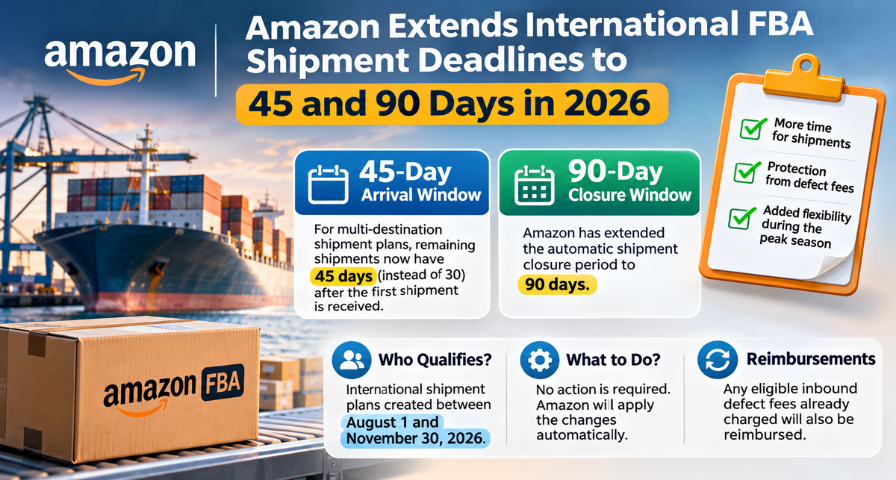
Considering the above-mentioned, Amazon has taken the decision to temporarily prolong the deadline for shipments to FBA from 30 to 45 days for all the international shipments in the multi-destination plan as well as to prolong the deadline for the automatic shipment closure period to 90 days. This data is very useful for those sellers who prepare themselves for the Amazon FBA peak season. However, in order to benefit from it, one should learn about the exceptions from it as well as ways to receive reimbursements.
What Amazon Changed in Its International FBA Shipment Policy
There are two changes, and both are about how long your inventory has before Amazon considers your shipment defective. It would be better to keep them separate since sellers often confuse these two terms.
Firstly, you need to know about the change related to multi-destination shipments. If you ship international FBA shipments, Amazon will always split them into several shipments. Once the first shipment is accepted by Amazon, a new deadline starts for others. The old deadline was 30 days, and now, it is 45. If your shipments arrive during this time, then Amazon will not charge you any deleted or abandoned shipment defect fee.
Secondly, you should know about the automatic closure. Amazon will close all the shipments that are open for too long. Now the deadline for eligible shipments is 90 days.
Understanding the New 45-Day Arrival Window
This 45-day period is relevant only if the plan includes several destinations and its timing starts once you receive the first shipment from the supplier. It doesn’t matter if you created the plan and the shipment left the supplier’s place. This aspect causes misunderstanding, and hence, an example can clarify the situation.
If Amazon receives the first shipment of your plan on November 5, then under the former 30-day rule, other shipments should be delivered by December 5. But with the new window, it should be delivered by December 20. These additional two weeks can be crucial in avoiding fines and fees especially if there is a delay in delivery due to release from customs or delay in shipping vessel. Please note that the above dates are only an example. The actual rules that Amazon uses to count days should be considered.
The key takeaway is that you should record the receiving date of the first shipment. Sellers usually remember the creation date but don’t know about the receiving date.
Understanding the 90-Day Amazon Shipment Closure Policy
While automatic closure can be seen as an administrative note, it becomes significant in case of delay of the goods. Opened shipment means shipment expected by Amazon through Seller Central. In case the shipment remains open beyond the deadline for closure of the shipment, then it is automatically closed, and this might require making of another plan or resolving the received goods.
An extended period of 90 days provides more chances for the eligible shipment to remain opened until the international transportation of the shipment, customs clearance, and the reception of the goods have been accomplished. In case a shipment finds itself in a long-term hold situation, then there would be less chance of its closure until the broker sorts out the documentation. The provided announcement does not give any information about the previous closure period; thus, please find this information from Amazon's official notification.
It is not equal to automatic. Sellers should continue monitoring their shipment status in Seller Central since the extended closure period is not equivalent to investigating missing inventory, discrepancies, or other inbound issues.
Who Qualifies for the 2026 FBA Deadline Extension
For the purpose of deadline extension, the affected international shipment plans will be those that have been created from August 1, 2026 through November 30, 2026. It will be the date of creation of the plan on Seller Central that will matter. In case of plans created on November 28 and those created on December 2, it is the former that will get the benefit of deadline extension regardless of the fact that they use the same route and suffer the same delays. Not all international shipments qualify for the deadline extension. Therefore, it is best to check the creation date of each plan separately.
In view of the fact that the deadline is imminent, it might be good to know at what point it will end. In this context, what I would not advise is making unnecessary shipment plans so as to make use of deadline extensions. This could create more problems than benefits, because the rules of deletion and abandonment of shipment are there for some reason.
Automatic Reimbursements and FBA Inbound Defect Fees
One of the nicer aspects of this announcement is how little it asks of sellers. There is nothing to apply for, no form to complete, and no support case to open. Amazon applies the changes automatically to eligible plans.
There is also a retroactive component. If a qualifying shipment has already incurred an inbound defect fee, Amazon will issue a refund of the fee. Good news for a seller whose account was just debited due to a delayed shipment. However, note the term "eligible." This is not a general waiver of all FBA inbound defect fees, but only of those that are associated with the extended shipment. It makes sense to check your recently incurred fees and determine those eligible within the timeframe and reconcile the credit against your shipment schedule.
One point needs special consideration. The defect will be registered on your Inbound Performance Dashboard despite the absence of the fee. There is no financial penalty in place, but there may be an item left in the system. Do not worry about that if you see that an item persists. However, it is still important to pay attention to your inbound metrics in general, since repeated shipment flags are something to know about anyway.
Why Amazon Introduced This Change
However, Amazon has not provided an explanation for the changes, and thus, the following information is based on industry interpretation and not a definitive explanation of the reason behind the move. Deadlines are needed to ensure efficiency of the fulfillment processes. Amazon would like to have shipments coming in the right order without any open shipments left indefinitely, and the penalty charges serve as deterrents for the sellers who make the plans but fail to complete them.
These rules are developed in accordance with the ordinary circumstances, and during the time of congestion or customs hold of the goods that comply with the rules, the seller can meet the deadline by no fault of his. This fee in such a case means the punishment for uncertainty rather than bad planning. Moreover, extending the deadlines can help have more inventories shipped to the system during the time of high demands.
How the Extended Deadlines Affect Costs and Operations
In terms of finance and operation, there are three main advantages. The first one is decreased fee risk. The number of packages that become either deleted or abandoned will decrease, and all appropriate fees previously incurred will be returned to the seller.
This leads us to the second advantage that requires additional comments. In case of delays during multiple destination shipments, there is a possibility of taking more time instead of rushing with the expensive expedited freight to deliver in 30 days.
However, it is important to note the warning for the second advantage. Some sellers might be motivated by the possibility of choosing slower and cheaper freight for following legs of a plan. While it can work in some cases, there is no guarantee that it will work forever since the slower freight still has its disadvantages. It is better to treat it as a business opportunity rather than a loophole.
The third one is easier to account for. It is much easier for sellers who recorded the fees at the moment of their occurrence to reconcile the accounts compared to those who have to restore the situation.
The Difference Between Avoiding Fees and Maintaining Availability
It is here that sellers typically go wrong, and it becomes crucial when planning their inventory internationally. Consider a seller getting ready for the holidays whose goods are stuck at the port. The shipment is within the 45-day window, so no eligible defect fee is charged. It is a definite money-saving situation.
However, the seller will not be able to sell the items until Amazon gets them and processes them. Whether the shipment meets Amazon's deadlines or not, inbound compliance is one thing. Another thing is inventory availability, which determines sales, advertising performance, and organic ranking. An out-of-stock listing during the peak period may lose its momentum, and it will take weeks to recover it, and all the money spent on ads targeted at non-existing inventory just goes down the drain. The seller passes one test and fails another one.
That is why you should plan inventory in transit separately from inventory available for sale and continue tracking estimated receiving dates of top-performing ASINs. Use the extension to protect yourself from fees, not empty inventory.
Why International Sellers Should Pay Attention Before the Holiday Season
The 2026 peak season increases the stakes for every step in the supply chain. In addition to having to consider at what point inventory is shipped from the supplier, it is also imperative to consider at what point it is ready to be sold through Amazon. While the extra time helps when it comes to shipping delays, this does not reduce the possibility of missing sales opportunities.
In the case of businesses relying on ocean shipping, it would make more sense to maintain sufficient inventory buffers rather than to treat an extended deadline as the core replenishment strategy. After all, even the deadline which you can miss without being penalized remains a deadline for your clients.
What Sellers Should Do Before November 30
Following a few easy steps will make this period useful for you. First of all, find out the creation dates of your international plans to determine their eligibility. Next, if you have multi-destination plans, note the day the first shipment is delivered and track all the rest within the 45-day period. Monitor the open shipments in Seller Central during the 90-day period and look for the relevant information at the Inbound Performance Dashboard. After that, you can check the fee credits over the next several weeks to ensure that you get the money back.
To complement these actions, it is important to document all shipping delays properly. For example, if the shipment is delayed at customs, keep notices, dates, and communications with your freight forwarder or broker. It will also be useful even if the fee was automatically waived to solve all possible discrepancies easily. Do not forget that freight partners may not be always aware of extended periods of time.
What Amazon’s Temporary Extension Does Not Cover
Extra time is easily misconstrued as foolproof protection, and that is why it makes sense to be aware of their limitations. This announcement will not speed up the process of receiving, guarantee against customs delays, avoid stockouts, or exempt you from all inbound defect fees. It covers certain aspects: the deadline of arrivals for outstanding shipments in the qualifying multi-destination shipment plans, the automatic closure period, and the reimbursement of the eligible fees.
It is temporary and linked to a particular period of shipment creation. Any shipments created out of this period are subject to regular procedures, which means relying on extended deadlines may result in losses when they expire. Take advantage of extra time as an additional cushion while at the same time enhancing the aspects under your control, like labeling and documentation.
Final Thoughts for International FBA Sellers
Amazon is providing international sellers with additional time to address any delays in their shipping: 45 days of remaining ship days for the multi-destination plan, automatic closing for 90 days, and automatic reimbursement of inbound defect fees for those eligible for the plans that are created between August 1 and November 30, 2026. However, additional deadline leeway is not a substitute for good inventory management practices.
Find out what your options are, be mindful of your dates, look out for reimbursements, and plan like you have an additional buffer, but not a guarantee. Those sellers who pay attention to policy changes and react accordingly always end up benefiting when the next round of port delays comes around at its expected date.
Ready to Grow on Amazon?
Let our experts help you scale your Amazon business with proven strategies.
Get a Free Consultation
Comments (0)
Leave a Comment