Amazon Extends FBA New Selection Program Deadline to March 31, 2027: Benefits and Eligibility Explained
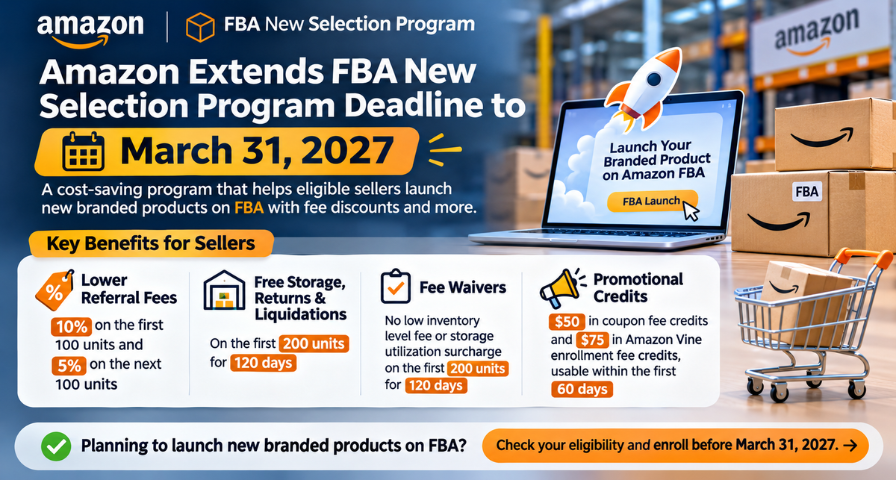
Launching a physical product is expensive in ways that don’t always show up in the spreadsheet. You pay for inventory, photography, packaging, and ads, and then Amazon starts charging for referrals, storage, and returns before you have a single review. The Amazon FBA New Selection Program exists to soften that early squeeze, and the latest update gives brand owners more time to use it. Amazon’s program page now shows introductory access running through March 31, 2027. This guide explains what that date means, what the 2026 program offers, who qualifies, and how to plan a launch around it.
What on March 31, 2027? Date Actually Means
The new program was an upgrade from the previous New Selection Program that came to a close on July 30, 2026. As per Amazon's page for the program, any sellers who were signed up for the previous New Selection Program were automatically signed up for the new one as well as of July 30, 2026, and they will have access until March 31, 2027, as an introduction. Previously, October 31, 2026, was suggested as the last date, and that makes March 31, 2027, good news for all concerned sellers.
It helps to be precise about what the date is. It marks the end of the introductory access period, and it does not stretch any individual benefit window. A product still has to meet the eligibility rules, and each benefit runs on its own clock, which I explain below. Amazon also states that products already enrolled in the previous program keep their current benefits until those benefits expire, so you don’t lose what you’ve already earned. The page directs sellers to its “How to enroll” section for the steps to keep receiving benefits beyond the introductory period, so read that section in your own account before assuming you are covered.
What the Amazon FBA New Selection Program Is
In Amazon’s own words, the program helps minimize upfront costs and speed up discoverability when introducing new branded products. Professional sellers who meet certain conditions can earn fee credits, depending on sales performance in the first days, get free storage, coupon credits, Vine promotional credits, and value recovery for new-to-FBA parent ASINs. After joining, a seller has access to these advantages for an unlimited number of new parent ASINs per year.
On the ground, it is a safety net. Amazon needs more unique branded products on its platform, and the launch of a new product with no reviews and sales history is a gamble for the seller. Reduced fees temporarily make the gamble less costly, making it more likely that sellers will try out their products.
What Changed in the 2026 Version
The headline change is how the savings arrive. Seller-industry analysis describes the 2026 version as a move from a back-end sales rebate to instant fee credits, with higher unit ceilings than before. One breakdown summarized it as instant referral fee credits in place of a rebate, with unit ceilings roughly doubled. The practical effect is visibility. A credit that appears alongside the transaction shows up in your fee reports as orders happen, so you can judge your real margin on early sales instead of waiting to see what comes back later.
How the Referral Fee Credits Work
Referral fees are capped at 10% on the first 100 units and 5% on the next 100 units. The mechanism deserves care, though, because these are not a permanent cut to the published referral rate. Amazon describes them as equivalent fee credits that can be applied across major fee transactions, including referral and fulfillment, for the same order. The program rate acts as a ceiling, so if your category’s normal rate is already lower, you shouldn’t expect extra savings.
A worked example makes this concrete. Say you sell a product at $30 in a category with a standard 15% referral fee, which is $4.50 per unit. On each of the first 100 units, the capped 10% rate works out to $3.00, a saving of $1.50 per unit, or $150 in total. On the next 100 units, the capped 5% rate works out to $1.50, a saving of $3.00 per unit, or $300 in total. Across all 200 units, the illustrative saving is $450. Your actual figure depends on your category’s fee rate and Amazon’s credit calculation, but the example shows why the first 200 sales are where the program does its heaviest lifting.
Storage, Returns, and Liquidation Benefits
The second group of benefits targets costs that quietly erode early margins. Storage, returns, and liquidation costs are waived for 120 days on the first 200 units of new branded FBA products. Certain charges, including the storage utilization surcharge and the low inventory level cost, are also waived for those units. Returns processing is covered for up to 200 units per parent ASIN, as long as returned items reach a fulfillment center within 120 days of when inventory was first received.
These waivers matter most for cautious sellers. A small, carefully sized first shipment can easily trigger inventory-level penalties, and a product with a sizing or quality quirk can generate returns before you’ve learned anything useful. Having both covered for a defined stretch lets you focus on testing demand.
Coupon and Vine Credits
Promotional support is the part sellers most often leave on the table. Eligible products receive $50 in coupon fee credits and $75 in Vine enrollment fee credits, usable within the first 60 days of listing a buyable offer. The Vine credit covers 3 to 10 units per parent ASIN, and the product must be received at a fulfillment center and enrolled in Vine within that 60-day period.
Both these tools try to solve the same issue, which is that of trust. A consumer viewing a product without any reviews will have no reason to go for it, considering the competition around. The offer of a coupon gets them to consider while Vine makes the product reach the review stage.
Two Clocks, Not One
This is where launches often go wrong, because the benefit windows don’t all start at the same moment. The storage and related waivers run for 120 days from the first FBA inbound date, and returns must be received within that same 120-day window. The coupon and Vine credits run on a separate 60-day clock that starts when you list a buyable offer. So your inventory clock starts when stock lands, and your promotional clock starts when the listing goes live.
The lesson is to line them up on purpose. Don’t ship stock months before you can sell it, and don’t list a product before your inventory is on its way. The page also notes that program terms apply, so read the full terms for conditions beyond what is summarized here.
Eligibility Requirements in One Place
Eligibility is scattered across several pages, so here it is in one place. Based on Amazon’s program page, you need a professional selling plan (in normal or vacation status), a maximum trailing six-month Inventory Performance Index score of 300 or higher if you have an assigned score, and FBA enabled for your eligible ASINs. Sellers without a score can still enroll, but your score matters once you have one.
On the product side, Amazon says eligible items are branded new-to-FBA parent ASINs only, meaning no FBA shipment in the past 12 months by any seller. Both standard-size and non-standard-size items are eligible. That 12-month rule deserves attention. It is assessed at the parent ASIN level, so the product’s history is the test, not your own history with FBA. An item that sat out of FBA for over a year may qualify, while adding a new color or size as a child variation under a parent that was recently fulfilled through FBA generally won’t. Amazon’s terms also list product exclusions, so check the full list for your category before you commit inventory. Seller Central offers a new-to-FBA product search tool where you can check by ASIN, EAN or UPC.
How It Interacts with New Seller Incentives
If you are a newer brand owner, you may also qualify for Amazon’s New Seller Incentives, and the two don’t simply stack. Reporting on the terms says the benefits unique to New Selection are not affected by the sequencing and that overlapping benefits shift over to New Selection only once the other incentives are exhausted or expire. A sensible reading is that overlapping categories, such as referral credits, Vine, and coupons, draw down the New Seller Incentives first, while benefits that are unique to this program, such as free storage, returns, and liquidations, remain available alongside them. Check how your dashboard treats your account, since the details can vary by situation.
A Launch Example: Private-Label Cotton Towels
Think of an example of a seller that launches a new branded range of cotton towels. The seller conducts research to determine the need for such a product and analyzes competitors’ reviews. After that, the seller uses the new search feature for the parent ASIN to ensure that there has been no FBA shipment by any other seller in the last 12 months. Then the seller ensures the professionalism of his/her plan and IPI score and then ships the first batch of about 120 units.
When the shipment is received, her 120-day inventory window begins. She times the buyable listing to go live close behind it, then schedules her coupon and her Vine enrollment in the first weeks, well inside the 60-day promotional window. Over the next four months she watches conversion rate, return reasons, and ad performance, and she tracks her savings on the program dashboard. If the towels perform, she scales into standard fees with evidence behind her. If they don’t, the downside was limited.
What the Program Does Not Cover
However, there is no such thing as free launch. This program does not subtract costs related to advertising efforts therefore, your PPC spending remains your own business. It does not make any other part of the FBA program free because it sets limits on the total number of credits you can get. Manufacturing costs, inbound transportation, and international shipping are not covered by this promotion program at all. This program will not ensure the sale of your products either. Furthermore, credits are awarded only to the qualified units, and, therefore, units over 200 (per parent ASIN) become standard again. Key Takeaways and Next Steps
The Amazon FBA New Selection Program offers instant fee credits on the first 200 units, 120-day relief on storage, returns and liquidations, and coupon and Vine credits to help a new listing earn its first reviews. Introductory access now runs through March 31, 2027, which gives brand owners more time to prepare, though it doesn’t extend the benefit windows on any single product. Your next steps are straightforward. Open the program page in Seller Central and read the “How to enroll” section. Check each parent ASIN with the new-to-FBA search tool. Size your first shipment to your forecast rather than to the program’s ceiling. And line up your 120-day and 60-day clocks before inventory ships. Done carefully, that turns an extended deadline into a real advantage for your next launch.
Ready to Grow on Amazon?
Let our experts help you scale your Amazon business with proven strategies.
Get a Free Consultation
Comments (0)
Leave a Comment