Amazon Can Now Deactivate Individual FBM Offers: What the 2026 Account Health Change Means for Sellers
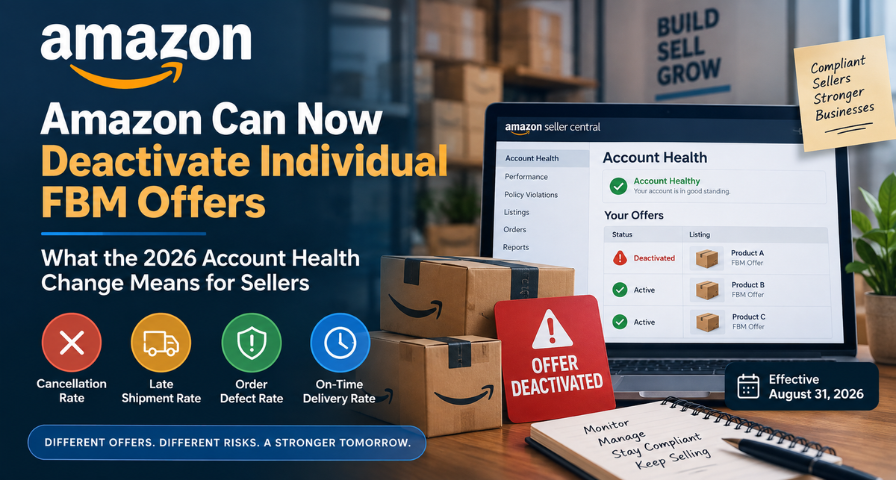
For years, account health metrics for Amazon sellers fulfilling their own orders have been a binary metric, one that represents a do-or-die metric. A period where the orders shipped were delayed or cancelled was a sign that the account was in jeopardy because one big slip-up would mean all the offers were in danger. This strategy is changing to become much more precise. Starting on August 31, 2026, Amazon will implement a more precise enforcement policy for FBM (Fulfilled by Merchant) offers, and it has implications for how Amazon sellers should view their risk exposure and monitoring practices.
It is not a small change hidden away in the fine print. This is a change in focus from account-level metrics to offer-level metrics, and for sellers with many SKUs, it has significant dollars and cents implications.
What Amazon Changed for FBM Offers in August 2026
According to Amazon's Seller Central announcement, if a specific FBM offer starts putting Account Health at risk, Amazon will now temporarily deactivate that individual offer rather than letting the issue spread to the seller's other active listings. Amazon states that the rest of a seller's catalog, along with their overall account health status, will not be affected by this particular enforcement action. Sellers are also supposed to receive a warning email before an offer is actually deactivated, giving them a chance to respond before losing the listing. If a deactivation does happen, the details can be reviewed under Account Health, in the Other Policy Violations section.
In this statement, the company mentions four distinct categories of performance associated with the review: Cancellation Rate, Late Shipment Rate, Order Defect Rate, and On-Time Delivery Rate. The four measures mentioned above constitute the core of evaluation of fulfillment for any FBM offer made by Amazon, and comprehension of each of them individually is more important than their combination into one metric.
Why Offer-Level Deactivation Matters More Than It Sounds
On the surface, this reads as good news. Deactivating one problematic listing instead of an entire seller-fulfilled catalog is more precise, and precision generally works in the seller's favor. But precision doesn't automatically mean low financial impact.
Picture a seller running 100 FBM offers, with 99 performing exactly as expected. The hundredth happens to be the seller's best performer, generating $18,000 a month in revenue on its own. Under the new system, if that one offer trips the wrong performance signals, Amazon can deactivate it while everything else in the account stays untouched. The account survives. The account health score may look fine. But the business still loses access to one of its most important revenue streams, possibly on the strength of a single warning email.
That reframes the core question FBM sellers need to be asking. It's no longer just "Is my Amazon account healthy?" It's "Which individual offer could become unavailable next, and what would that cost?" Amazon FBM offer deactivation no longer requires a systemic account failure. It can happen to one listing, in isolation, while the rest of the business looks completely normal from the outside.
How Amazon's Four FBM Performance Metrics Affect Offers
Cancellation rate reflects how frequently a merchant cancels an order after it is placed. Essentially, this metric will help to find out if this deal can be actually fulfilled by a seller once a client agrees to buy it. The late shipment rate is used to analyze how often the delivery is made after the expected date, which means that something goes wrong between the order placement and its transfer to the warehouse. Order Defect Rate shows all problems associated with the order on a customer service level, thus revealing if this deal brings more trouble than necessary for the clients. On-Time Delivery Rate, or OTDR, indicates how often the deliveries are fulfilled according to the promises.
That last distinction trips up a lot of sellers. A seller can ship an order exactly on schedule and still end up with a delivery problem once the package enters the carrier network. Likewise, a spike in cancellations might not be a shipping issue at all it might trace back to poor inventory management upstream. Treating all four metrics as interchangeable symptoms of "bad fulfillment" misses where the actual fix needs to happen.
Why On-Time Delivery Deserves Special Attention
Among the four metrics, perhaps most deserving of scrutiny is that of on-time delivery, as it is the metric influenced by the most variables not in the hands of the seller. The FBM order is generally subject to a number of stages before completion, including receipt and acceptance of the order within the delivery window; processing, involving the picking, packing, and loading of the order to be collected by a carrier; handover to the carrier and the beginning of tracking; and finally reaching the client within the promised delivery window.
The update by Amazon for OTDR in February 2026 had a similar philosophy as the one presented in the August announcement. In its update, Amazon retained the current 90 percent on-time delivery criteria for the seller-fulfilled listings, but modified the company’s approach to sellers failing to maintain the standard. The new approach stated that Amazon will deactivate only the listings contributing to the lowest part of the performance rate, while keeping other listings intact. Amazon has clearly indicated that serious underperformance or continuous failure to comply with the criteria may eventually lead to deactivation of other listings.
Your Delivery Promise Is an Operational Variable
One of the key considerations about FBM that gets neglected quite frequently is the discrepancy between the time needed for actual fulfillment versus what's stated in the listing. If the business requires three business days to complete preparation for shipping of an order, but the listing assumes a one-day handling time, then the seller made a promise that can't be kept by his or her operations in an effective way.
It's not about speeding up the process, whatever it takes. The point is to create a promise to your customers that you could keep consistently. An FBM operation that is sustainable will look as follows: first, make a promise based on realistic capacity for preparing orders; second, do everything you could to process orders in such a manner that the promise would work; third, hand orders off to the carriers on time; fourth, monitor deliveries effectively.
Building a Practical Offer Risk Monitor
Although Amazon does not impose such a policy on its sellers, creating an internal rating system is one of the ways for FBM sellers to spot potential problems in advance. For crucial SKUs, it is necessary to monitor the adequacy of inventory and the ability to consistently fulfill orders, because the inability to do so often results in cancellations. One should also see if the announced handling time corresponds with the real handling time, as unreasonable promises inevitably result in delayed delivery. It is important to monitor whether orders are acknowledged in advance of the shipping deadlines and if the carriers scan and move packages without delay. From the customer's side, monitoring whether packages arrive within the announced timeframe becomes a part of monitoring OTDR. Revenue exposure is no less important than performance data, as awareness of the monthly revenue from a particular offer becomes the primary focus of attention.
A simple four-level framework makes this easier to manage. Offers performing normally sit in a stable category needing no immediate action. Offers showing early signs of decline move into a watch category worth closer attention. Offers with recurring shipment or delivery problems fall into a higher-risk category needing active correction. Any offer that has triggered an actual Amazon warning or deactivation notice belongs in a critical category requiring immediate response. This isn't an official Amazon scoring system, it's a management lens, but its purpose is straightforward: catch deterioration before Amazon's automated systems catch it first.
What to Do If Amazon Deactivates an FBM Offer
Should the deactivation notice come through, sending an apology does not do the trick. Instead, one would be better off figuring out the exact offer that has been deactivated and examining the specifics of the deactivation in Account Health Other Policy Violations. Next, it is necessary to determine which metric was the reason for the deactivation that might have been a problem with cancellations, late shipments, order defects, or delivery performance. After the metric is determined, the real cause behind the problem should be found out, which can include inventory issues, overly optimistic handling time, warehouse issues, carrier reliability problems, and customer service issues. The issue needs to be resolved at its source rather than with mere declarations about future improvements.
The Bigger Picture: Amazon Is Becoming More Granular
The announcement made in August 2026 regarding the FBM program was not made in a vacuum. It follows from the same principles that were used in the OTDR announcement made by Amazon in February 2026. In this announcement, the company switched from deactivation to focusing on the exact listings that cause the deterioration of the rating. Both of the announcements give us a clear idea of the trend in which Amazon is heading, that is, from account-based enforcement to enforcement based on listings.
What This Means for High-Volume Sellers
A seller managing five FBM listings can probably track all of this manually. A seller managing hundreds or thousands of offers is facing a prioritization problem instead. The operator needs a clear answer to which offers are currently generating performance risk, which offers generate the most revenue, which show deteriorating fulfillment metrics, which depend on unreliable suppliers or carriers, and which products might need a different fulfillment model altogether, such as a shift toward FBA. The goal isn't to eliminate every minor operational fluctuation, since that isn't realistic. The goal is to prevent a small, contained issue from becoming a large commercial one.
Key Takeaways
However, in this case, the latest change introduced by Amazon on August 31, 2026, is about the threshold of performance at which FBA sellers have to manage their listings, rather than the threshold for enforcement by Amazon. In other words, enforcement becomes more selective, allowing Amazon to temporarily remove a particular offer without necessarily threatening to close the entire seller-fulfilled inventory of the seller who faces the issues. The good news is that this approach does not mean lower risks because the single highest-performing listing may vanish any moment due to a too-high cancel rate, a too-high late shipment rate, a too-high orders defect rate, or a too-low on-time delivery rate.
Ready to Grow on Amazon?
Let our experts help you scale your Amazon business with proven strategies.
Get a Free Consultation