Amazon Bulk TRF Submission Update: What Sellers Need to Know About TIC Compliance
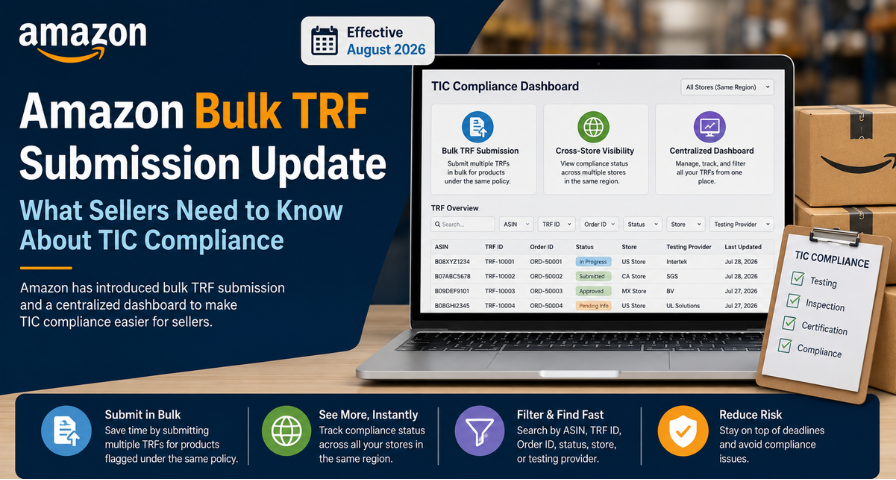
Amazon has made a practical change to its product compliance workflow that could save sellers considerable administrative time. Sellers dealing with Testing, Inspection, and Certification (TIC) requirements can now manage multiple Test Request Forms (TRFs) in bulk while also getting a centralized view of compliance activity across eligible stores in the same region. In August 2026, this update replaces a process that previously required handling every flagged ASIN in every store, one submission at a time. For sellers managing Amazon TIC compliance across multiple products and stores, the difference could be substantial.
To understand why this matters, it helps to picture the old workflow. If you sell products in a category where Amazon requires third-party verification, and several of your listings get flagged under the same policy, you previously had to work through each one individually, generating a separate TRF, tracking it separately, and repeating the same steps again for the next product. For sellers with only one or two flagged items, that was manageable. For sellers managing larger catalogs or multiple storefronts, it added up into a lot of repetitive, error-prone administrative work.
What Exactly Changed
The update introduces three distinct improvements to how sellers manage TIC-related compliance. First, sellers can now submit TRFs in bulk for multiple products flagged under the same policy, rather than initiating each request separately. Second, Amazon has added cross-store compliance visibility, allowing sellers with multiple storefronts in the same region to view status across those stores without logging in and out of separate Seller Central accounts. Third, all of this is accessible through a centralized dashboard, with filtering options for ASIN, TRF ID, Order ID, status, store, and testing provider.
It's worth being clear about what this update does not change. The update does not change the underlying compliance requirements for products that are subject to TIC verification. Products that require testing, inspection, or certification still need to go through that process and still need to meet the applicable regulatory standards. The core compliance steps, including working with an approved TIC provider and providing the required documentation or samples, remain part of the process. What Amazon has changed is how sellers initiate and track that process, not what the process requires.
Why the Old Process Was Difficult
The friction in the previous system came from its lack of consolidation. Compliance status, submission history, and provider details were all tied to individual ASINs and individual stores, with no shared view across them. For sellers operating in categories where testing requirements apply broadly, such as toys, dietary supplements, or certain electronics, that structure meant a lot of manual tracking. A seller managing affected ASINs across several regional stores could easily find themselves handling dozens of individual submissions and status checks, none of them linked in any meaningful way. That's not just inefficient. It also increases the chance that something gets missed, and a missed compliance deadline can carry real consequences, including enforcement action on the affected listing.
Why the New System Actually Helps
This update can be analyzed from the standpoint of three different aspects. It would not be proper to simply say that it saves time because there are other factors that should be considered. First of all, it improves efficiency. If several products require compliance with the same policy, it does not make sense to perform identical procedures on each of them, while bulk submission eliminates the redundancy. Secondly, this update offers visibility. By using cross-store tracking, sellers are provided with an overall look at how compliant their products are at a particular moment. Finally, it facilitates risk management because it provides sellers with a more comprehensive dashboard that will be easier to filter and avoid overlooking some items. It may be noted that the last point deserves particular attention because the costs of neglecting the deadline can be much higher than the amount of time saved by bulk submission.
Related submission grouping can also help internal organization, especially if several ASINs are being coordinated with the same test agency. Instead of tracing a sequence of independent emails or Excel files, the seller now has a single location where a group of similar requests can be accessed, which is a considerable enhancement for any ongoing activity management process, not a sporadic one.
Who Should Pay Attention to This
This update is most relevant to sellers with a meaningful number of ASINs subject to Amazon's testing, inspection, or certification requirements, or those operating multiple storefronts within the same region. Many products in categories such as toys, dietary supplements, electronics, and other regulated or restricted product areas may be subject to these requirements, though the specifics depend on the product, the applicable policy, and the marketplace involved. Sellers who only occasionally encounter a compliance flag may not notice a major shift, since the core testing steps remain unchanged. But for anyone managing this at scale, across several products or several stores, the reduction in repetitive administrative work is significant.
Final Thoughts
The most important thing to understand about this update is what it is and isn't. Amazon hasn't made TIC compliance optional, and it hasn't reduced the underlying testing requirements in any way. What it has done is make the process considerably easier to manage, particularly for sellers coordinating compliance across multiple products and stores. The compliance work itself hasn't gone anywhere. The administrative burden around it no longer has to be as heavy. If your business regularly deals with TIC verification, it's worth logging into Account Health, exploring the new bulk submission flow, and getting familiar with the filtering options before your next wave of compliance notices arrives.
Ready to Grow on Amazon?
Let our experts help you scale your Amazon business with proven strategies.
Get a Free Consultation