Amazon Brand Registry Reporter Assistant: How AI Is Changing IP Reporting
If you have ever filed an intellectual property complaint on Amazon, you know the feeling. You spot a counterfeit or a seller using your photos, and you are certain about what happened. Then the form asks you to pick an infringement category, attach evidence you are not sure qualifies, and fix a validation error that never quite explains the problem. For many brand owners, the paperwork takes longer than finding the violation.
The Amazon Reporter Assistant is designed to shrink that gap. This article covers what it does, who can use it, how it changes day-to-day brand protection, and where its limits sit.
What Is the Amazon Reporter Assistant?
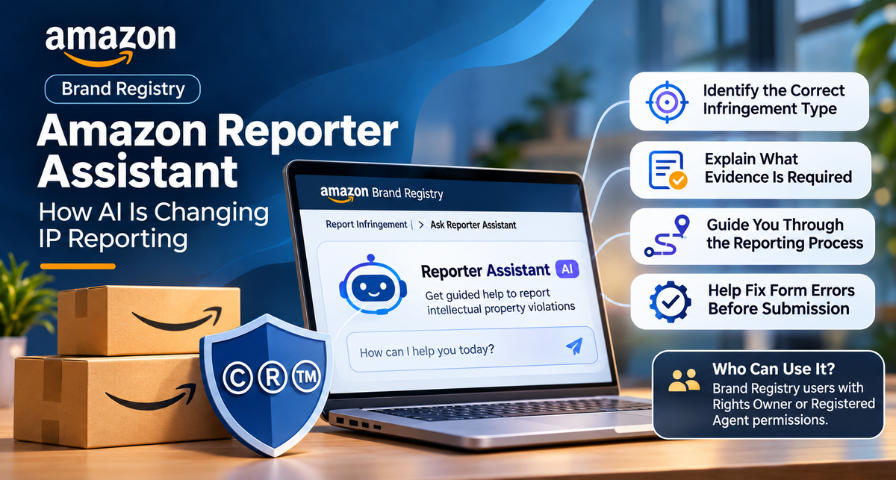
The Amazon Reporter Assistant is an AI-powered guide inside Brand Registry that supports users while they prepare an infringement report. You reach it by going to Brand Registry, opening Report Infringement, and selecting Ask Reporter Assistant. Think of it as a knowledgeable colleague beside you as you build a case. It prepares the report, while Amazon’s standard review and case resolution process stays exactly as it was.
Traditional IP Reporting vs. AI-Assisted Reporting: What’s Different?
In the traditional process, the seller carries every step alone. You decide which category your problem belongs to, research what evidence Amazon expects, work through the form fields, and often learn about mistakes only after a rejection. Each of those steps now has support. Instead of guessing a category, you describe the situation and get a suggested route. Instead of hunting for requirements, you get them explained. The form is walked through with you, and errors can be caught before you submit.
The last step is unchanged. Amazon still reviews the complaint and makes the call. AI improves the preparation experience, not Amazon’s enforcement authority or the final decision.
What the Reporter Assistant Can Actually Do
Four capabilities matter most. It helps identify the correct infringement type, which prevents the classic mistake of attaching good evidence to the wrong claim. It explains what evidence is required, so a seller reporting copied images knows what ownership proof to gather before starting. It guides you through the reporting process, so the sequence of fields and uploads feels logical. And it helps fix form errors before submission, which avoids a rejected case during a counterfeit surge when every day costs sales.
Understanding Trademark, Copyright, Patent, and Counterfeit Violations
The assistant is most useful when you understand the categories it is choosing between. A trademark violation involves unauthorized use of a registered brand name or logo, though not every use is automatically infringement, since authorization, context, and the scope of your registration all matter. A copyright violation involves copying original creative work, such as product photography. Listing text can qualify too, but only if it is original enough to be protectable. A patent violation involves using a patented invention without permission, and these claims follow stricter rules. A counterfeit violation involves selling a fake product presented as genuine, and it often overlaps with trademark infringement, so the categories are not mutually exclusive.
Claims of patents must receive additional consideration. In accordance with guidelines posted on Amazon's seller forums, identification of possible violation of a utility patent needs either a court order, an International Trade Commission order, or an Amazon Patent Evaluation Express (APEX) ID to fill out the form. The APEX service, in turn, at the present time, is provided only for the US utility patents that have been registered.
Who Can Use It and What to Check First
Access follows Amazon’s existing permission logic. The Reporter Assistant is available to Brand Registry users with the Rights Owner or Registered Agent role, which mirrors Amazon’s rule that using the Report a Violation tool requires an account assigned one of those two roles for the brand. A teammate with a general login but no assigned role may not see the feature.
However, one important reminder about trademarks. Amazon has made it clear that brand owners with pending trademarks cannot make use of the "Report a Violation" option until their trademarks have been completely registered. I was unable to verify whether or not the same rule applied to the reporter assistant as well.
Why Amazon Is Bringing AI Into IP Reporting
Amazon has been simplifying reporting for some time. It recently announced a single guided experience for reporting IP infringement, store policy violations, and regulatory compliance concerns. A conversational assistant fits that direction naturally.
Amazon has reported that it investigates and takes action on more than 95 percent of notices from Brand Registry within eight hours. That figure describes Amazon’s handling of notices, not a guaranteed resolution time, and it says nothing about whether the assistant speeds anything up. The more reasonable inference concerns input quality. Review systems work better when reports arrive complete and correctly categorized. Accuracy also protects sellers, since Amazon’s policies treat false, misleading, or consistently inaccurate notices of infringement as a policy violation. That does not mean every rejected complaint triggers a penalty, but careless reporting carries real risk.
A Practical Example: Stolen Product Photography
Imagine a private-label seller who discovers a competitor using her original product photos on a rival listing. Her instinct is to file a trademark complaint, because her brand feels copied. She opens the assistant and explains what happened. It points her toward a copyright framing and outlines what supporting information may be needed. She then does the human work: pulling the original image files with their creation dates, confirming she owns the rights, and checking that the reported listing really matches. Only then does she submit. The assistant shortened the learning curve, but she supplied the proof.
How It Could Change Brand Protection Operations
For growing brands, the shift is mostly about access. Picture a seller with 20 products who suddenly faces copied images and brand assets. Learning every reporting rule from scratch used to eat days. Guided help makes the process easier to grasp. Still, AI may lower the operational complexity of brand protection, but it does not lower the legal requirements for proving ownership or infringement.
Established brands managing hundreds of ASINs gain consistency. When several people file reports, and staff turnover erodes institutional knowledge, the same guidance applied each time keeps report quality steady.
Agencies face a permissions question first. Managing several clients means different brands and rights, so team members need the correct Registered Agent permissions where applicable. A feature that is invisible to the wrong role helps no one.
What the Reporter Assistant Cannot Do
A polished report on a weak claim is still a weak claim. The assistant cannot verify that you hold the rights you assert, and it is not a legal advisor. Three risks stand out. Classification can be wrong in a complicated dispute. Evidence can fall short even when you know what is required, and you remain responsible for its accuracy. And overreliance is tempting, because a confident suggestion can feel like permission to file.
Consider a seller who holds only a design patent and is steered toward a patent route. Given the utility patent focus of APEX described above, that suggestion deserves independent verification before anything is submitted. Another case is a suggested trademark claim in a country where your registration does not yet exist. For gray market goods, disputed ownership, or anything heading toward litigation, a qualified attorney is still the right call.
Best Practices for Using the Assistant
Come prepared before you open it, with registration numbers, listing links, screenshots, and any test purchase records. Treat a suggested category change as a reason to pause rather than override. Keep your own record of what you submitted and why, and verify high-stakes details against Amazon’s official policy pages, since rules shift and AI guidance can lag behind them.
Where AI-Assisted Brand Protection Could Go Next
None of the following is announced, so treat it as informed speculation. Evidence preparation is an obvious candidate, with AI helping sellers organize documentation before filing. The same conversational approach could make other compliance workflows easier to follow. Teams might also use it to standardize reporting across brands and marketplaces. The likely constant is human accountability for what gets submitted.
Final Thoughts
The Amazon Reporter Assistant makes the unglamorous part of enforcement easier, from choosing the right infringement type to catching errors early. It is open to Rights Owner and Registered Agent users and reachable through Brand Registry, then Report Infringement, then Ask Reporter Assistant. It does not change Amazon’s review process or guarantee any outcome.
AI can simplify reporting, but strong intellectual property protection still depends on ownership documentation, accurate evidence, continuous monitoring, and responsible reporting. Build that structure first: confirm who holds which roles, document your registrations, decide who files what, and then let the assistant sharpen each report.
Ready to Grow on Amazon?
Let our experts help you scale your Amazon business with proven strategies.
Get a Free Consultation
Comments (0)
Leave a Comment