Amazon Black Friday Strategy: Turn Prime Big Deal Days Data Into Q4 Growth
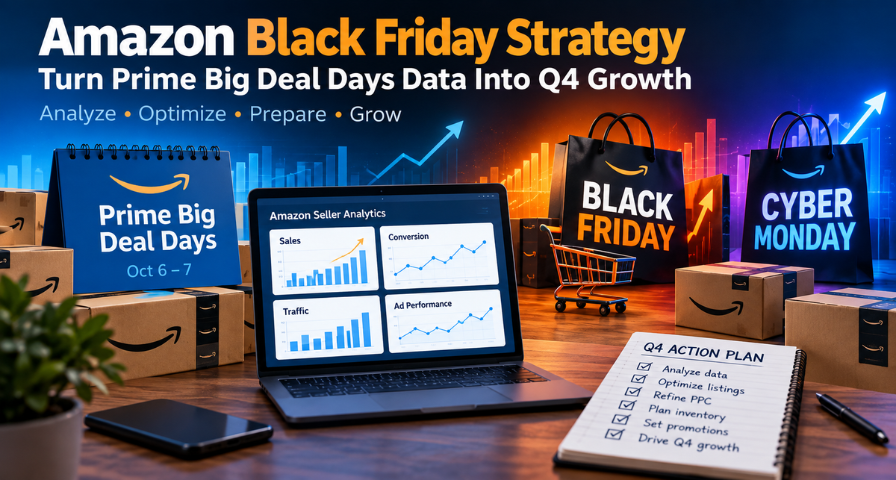
Prime Big Deal Days is right around the corner, and the majority of sellers will approach it as a sales event for survival. The smarter take is to consider this event as an experiment and the best one that is going to happen throughout the whole year, as it happens in the run-up to the most valuable weeks of the calendar. The October event is scheduled by Amazon on October 6th and 7th, and it is a 48-hour members-only sale event that will give you about three weeks until the final decisions regarding Black Friday and Cyber Monday.
Too many sellers look at the numbers being closed and immediately begin preparing for holidays without looking back. But a smart strategy for Amazon Black Friday is based on the opposite approach. It looks at October as the rehearsal period, analyzes the results and makes the remaining weeks of the quarter based on facts instead of last year's guesses. The current article discusses all of that.
Why October Works as a Rehearsal
A customer shopping during a Prime Day behaves in a different manner from one shopping on a regular Tuesday. The shopper shows up with purpose, makes price comparisons fast, and buys based on a much smaller rationale. It is the kind of behavior you should expect again on Black Friday, with even more competition and noise around.
The event could be viewed as a kind of stress test with a financial aspect involved. Your ability to convert during a time when competitors were doing promotions in your category says a lot about how good your listing was. If you had to pay double for clicks but saw no increase in conversions, it says something else about you, and figuring it out now is going to be much cheaper than trying to figure out in the last week of November.
Keep in mind the limitations. It is just a two-day event with very limited data and promotions can change metrics in many ways by increasing conversions artificially and messing up other numbers like organic rankings. Analyze the results curiously rather than dogmatically.
Get the Setup Right Before the Event Starts
You can only learn from this event if you gather clean data, so spend the next few days preparing for the event. The deadlines for submitting your deals have long expired, but certain options are still available. You may still use coupons during the event, and Prime Exclusive Discounts can be submitted 12 hours prior to the end of the event.
There is one thing you need to know about your Q4 marketing strategy. As stated in a seller news report, promotional prices from Prime Big Deal Days are not included in Amazon's deal lookback window, meaning that taking part in the event will not affect your ability to offer deals during Black Friday or Cyber Monday. This needs to be checked in Seller Central, but that's one less issue to worry about.
Prior to the start of the event, you should take a look at the statistics on your bestsellers: sessions, unit session percentage, average selling price, advertising budget, and inventory. Otherwise, you won't know what was affected by the event.
Reading Your Post-Event Data Without Fooling Yourself
In the days following the event, go to your business reports and take a look at sessions, unit session percentage (conversion metric used by Amazon), and buy box percentage for each top listing. Products that gained heavy traffic but had poor conversions have page issues. Products with strong conversions in light traffic have visibility issues. These problems call for completely different solutions, and confusing them is how budget gets wasted.
Take a look at the performance of each product against your four-week trailing average and not last year's results. Markets change quickly, and you want to see how much each product has improved in relation to its average performance. This lift is the best indicator of how it will behave under Black Friday traffic.
Finally, consider the quiet signals. Check returns for the event time frame, analyze reviews from that time period, and look at customer questions. Impulse shoppers tend to highlight expectation gaps in your images and bullet points, which regular traffic would have taken many months to reveal. If three customers have been asking if the product fits a certain place or device, your listing is missing this info.
Fixing Listings Before the Holiday Rush
Once you have identified those products that failed in terms of conversion rates, the job ahead will be relatively easy, namely: main image, start of the title, value story clarity, and proof elements of the page.
The main image works in search results, even before the click takes place. If the product had a high number of impressions but a low number of clicks, then it is time to experiment with a clear image featuring the product prominently. If clicks are high, but sales are not, then this is where a secondary image should be tested. It must illustrate the usage of the product, its size compared to some known element, and solve the major concern in the most effective way.
Most products bought in Q4 are gifts, and thus the customer buying the product is not necessarily going to use it. This means that you have to talk to this person. Highlighting which people are eligible for the product, what comes in the package, and whether this product comes gift-ready will make your offer more attractive. Adding a short note on packaging will eliminate any concerns customers might have about the gift even if they will not share it.
Timing is everything. Do your editing in the days following the occasion, make changes to one primary component at a time of your best-selling products, and test them out in traffic.
Rebuilding Amazon PPC for Black Friday
October knowledge is the most applicable and the least applied when it comes to advertising. As an example, during an important event, bids increase, and silent competitors begin to take part in the auction. Campaigns that seem profitable for a regular week suddenly become expensive. The results you received from your search term reports demonstrate this fact.
Firstly, divide terms into two groups those that brought you conversions with reasonable costs and those that brought you just clicks. Proved converters will have to occupy a very significant part in your Amazon PPC Black Friday strategy. Expensive and non-converted terms will have to be marked as negative, because otherwise, you will spend even more money on them during the fourth quarter.
Campaign structure is equally important to keyword selection. Keep keywords that proved their value in one campaign and run new campaigns in another one. If both types of campaigns use one budget, then all the budget may be spent on experiments, and you won't be able to measure their effectiveness. You can use separation to boost bids on proven converters.
Be sure to examine branded and competitive keywords as well. If you had your brand keyword searched by customers in the event and managed to grab most of those clicks and orders, protection of that area will be a bargain. If you were consistently losing to competitors on your brand terms, bid more aggressively on them.
Lastly, analyze budget pacing. It is common for many merchants to find their daily budgets exhausted by early afternoon. With the help of hourly data, decide on where to increase caps and focus your spending more in a few days where buyers are ready to purchase rather than spread it evenly throughout the quarter.
Amazon Inventory Planning for the Final Stretch
Inventory is the only component of Q4 that does not have a quick fix. Stocking out in the busiest week will hurt you both in terms of losing sales and organic rank since the disappearing product needs to regain its position. Too many units, however, will just gather dust in fulfillment centers and incur storage costs, which in Q4 are usually more expensive.
Utilize sell-through rates for October as demand signals, but use caution. If your product was selling better than anticipated, increase the forecast for Black Friday accordingly. Be mindful, though, of the fact that demand in November could be very different from that in October depending on the category, so do not assume that it will only grow. If your product was selling slower than expected despite having good traffic, hold your position.
Examine carefully the lead times. Verify the receiving times for the fulfillment centers that you are using now, as the delays usually worsen as the holiday season progresses. If it takes weeks for the product manufacturer to make and ship, you might have no option other than air freight, and this will need to be factored into your margins. For items that cannot be replenished, be cautious about the promotion budgets and advertising so that you don’t go through your supply too quickly. Make sure you know Amazon’s current cutoff date for inventory in Seller Central and not the one from last year.
Build Your Black Friday Action Plan
The calendar is quite precise. For instance, Black Friday is scheduled for November 27, while Cyber Monday comes the next Monday, November 30. It means that everything done in the period between the event in October and the holiday season can be broken down into several stages.
Firstly, up to mid-October, it is necessary to perform the analysis of the event data, choose winners, and determine what products have conversion issues and what products have visibility problems. Mid-October is a good time for fixing listings and restructuring advertising in a way that proven keywords would be separated from the experimental ones. Late October will be devoted to ordering the inventory, establishing the lowest acceptable price for promotions, and setting your creatives. Early November should be used for gradual scaling of campaigns to identify possible mistakes at an early stage. And finally, on Black Friday, pay attention to budgets, CPC, conversions, inventories, and deals.
Promotions need just as much discipline as anything else. Assess every discount in terms of bottom-line profit rather than units sold. A promotion that increases units sold but decreases margins by half will mean you have less cash on hand and higher inventory fees to pay. Do the math on every item, including advertising and fulfillment costs, and establish your minimum selling price before the promotion even starts. Bundling is worth looking at if you have items with high margins because they increase the order total without reducing the price.
Cyber Monday Is Its Own Campaign
However, your Cyber Monday plan should not resemble Black Friday. Considering the short period between two holidays, the main benefit is available to those who adapt quickly to the weekend's situation and adjust their efforts until Monday morning.
You need to analyze products that were sold successfully and the ones that failed. It is necessary to identify costly keywords and campaigns that ran out of the budget early. You should ask yourself whether the promotion was profitable for you or not. Then, based on the answers, you can adjust budget spending. For example, it can be the increase of budget in favor of products with positive conversion, pausing of costly keywords and reduction of discounts.
It is also worth reviewing your inventory at this stage. The product that has been sold faster than expected on Friday might run out of stock during Monday if you will spend the budget on its promotion with the same rate. Also, Cyber Monday shoppers usually include those who are completing their holiday shopping list; thus, clear shipping information and gift-ready messages are very important.
Using December to Close Out the Quarter and Learn
The following few weeks are characterized by shoppers that are operating under deadlines. The delivery date becomes an important consideration, and sellers that can provide delivery dates can snatch customers from their competitors. Stick to your marketing efforts for those that work and pay attention to your stock levels as the last deadlines for shipment approaches.
Make notes at all times. Note what changes were made, what transpired, and what decisions resulted in losses. This log will be more important next October than any sales figures, because it will turn the seasonal experience into a systematic process.
Key Takeaways
The Prime Big Deal Days event does not have any value in itself. The value comes from having actual shopper data prior to the arrival of the biggest shopping dates of the year. Get your baseline today, analyze it in terms of different metrics, and then optimize listings according to whether the issue is traffic or conversion. Push what works, drop what only generated clicks, and treat your inventory as the hardest thing about the whole plan.
What to do next? Just prior to October 6, document the baseline values of your top 5 items. Afterwards, compare the data and make yourself accountable for making at least one change in each listing based on the analysis. This shortlist of concrete actions will be worth more to your Q4 than any big list of nice ideas to do.
Ready to Grow on Amazon?
Let our experts help you scale your Amazon business with proven strategies.
Get a Free Consultation