Amazon Black Friday Deals 2026: Final Deadline for Best Deals and Lightning Deals
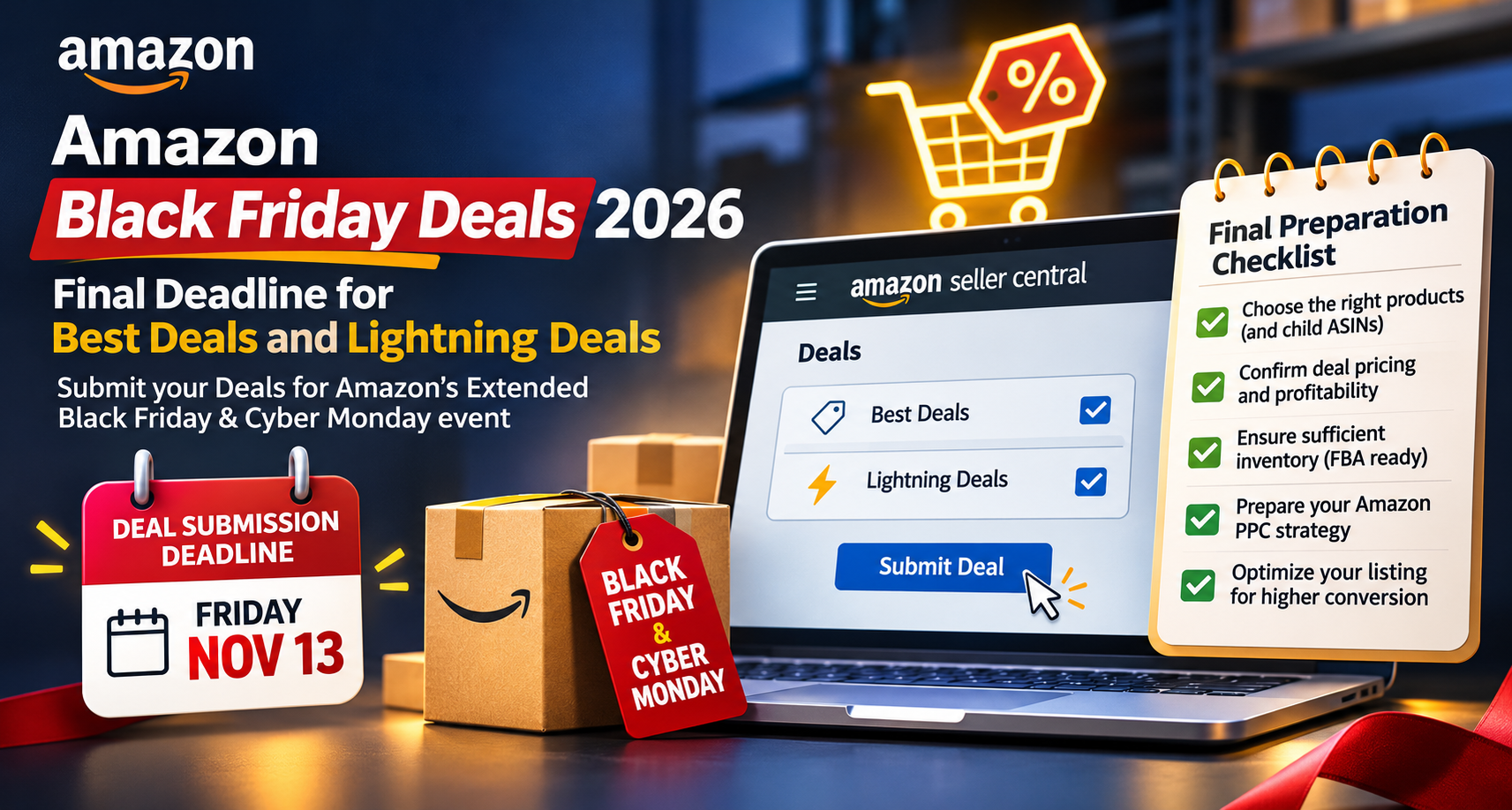
The Amazon Black Friday 2026 deals decisions are currently being made well ahead of time before anyone has even started browsing. The submissions to the Best Deals and Lightning Deals programs for the Extended Black Friday and Cyber Monday promotions at Amazon are closing this coming Friday, November 13th, in Seller Central. If you are reading this on Thursday, you only have a day left.
This doesn’t really give much information, so here is an answer to three questions. What kind of products should be promoted? How can you make sure you don’t end up selling yourself into a loss? And how can you be prepared with inventory and ads when the customers come rolling in? One thing to remember all along: more exposure does not mean better profits.
The November 13 Deadline: Submission Is Not Approval
The submission period for both Best Deals and Lightning Deals comes to an end on Friday, November 13th for the expanded event. The first thing that many sellers miss out on is that submitting a deal doesn't ensure its automatic acceptance into the event. Amazon reviews the eligibility, pricing, and inventory of deals, and then those accepted are scheduled accordingly. Submissions can be rejected or even flagged for a few corrections at times.
It should be noted that although the deadlines for submission come to a close on Friday, they don't mark the end of your concerns too. Once your deals have been accepted, it becomes important for you to finalize the deal price and date of the scheduled deal along with the ASINs to avoid making any mistakes beforehand. It might also be a good idea to refer to the event announcement on Seller Central because the eligibility criteria, fee structure, etc., might differ depending on the marketplace or deal type. This article doesn't provide any figures for precisely this reason, and the dates of the event can only be obtained from the official calendar of Amazon.
Best Deals vs. Lightning Deals: Match the Format to the Goal
The Best Deal is usually longer in duration and appears on the deals page of Amazon with a badge for discounts. The Lightning Deal is shorter in duration, with limited quantities, and creates urgency. Different scheduling and duration rules may apply for different events and marketplaces; make sure you verify them in relation to your submission.
Selection based on business objectives is preferable to selection based only on the product. A deserving product will get more time with a long deal, while the need to liquidate some extra stock before year-end might be solved via a short-term deal with limited quantities. But if your product is a best-seller that already sells very well, think twice if it requires any kind of promotion at all.
The latter is due to opportunity cost. If a product regularly sells 100 units daily at the full price, bringing you $13.50 per unit, which means $1,350 per day, and the deal helps you reach the sales of 130 units daily but profit drops down to $3 per unit, you will only earn $390.
Choosing Products, Down to the Child ASIN
It almost never pays off to just submit everything and let Amazon handle the rest. It is best to choose products with good reviews, good conversion, and no issues with fulfillment at all. Even a product with poor reviews and some bad experience with returns can work here, but deals will make any problems more prominent.
Now take a look at children below the parent. You might have a parent with twelve children in various sizes and colors, and this parent is doing great sales-wise, whereas two most popular variants have almost zero stock. Submitting deals for this parent will lead people to variants you cannot fulfill at all. But there is more to it than inventory: one variant may have a lot of stock and poor conversion, while another has more demand and better results with ads. Examine the stock, conversion rate, and advertising success for each variant and think about making a deal for only those that will be able to withstand it.
A smart short list should consist of three products: one for customer acquisition, one for clearing inventory, and one to reaffirm the position of an experienced seller.
Deal Pricing and Profitability
However, it is in pricing that the seller usually wins the deal but loses the money. Inflated "before" prices are easily identified by customers, and raising the reference price merely to make the discount seem larger may be rejected.
Work backwards from the actual cost. The contribution margin is the sales revenue net of all costs associated with a deal: the cost of goods sold, referral fees, fulfillment fees, any deal fees, and advertising. Below is a sample calculation using dummy numbers; replace them with your own. The product is priced at $40, and the cost of goods sold is $12. If sold at full price, the referral fee is $6, fulfillment is $5.50, advertising costs are $3, and there is a remaining gross profit of $13.50. Now offer a 25% deal at $30. The referral fee becomes $4.50, fulfillment remains $5.50, advertising remains at $3, and I've added a $2 unit promotional fee. There may be other ways the deal fees could be structured; don't assume a per-unit fee. The net profit drops to $3, which is a decline of about 78%. You would need five times as many units to equal the full price profit.
This profit is contribution margin profit and not bottom-line net profit. Other factors like storage, return, tax, and overhead costs will eat into this profit margin even further. This is another reason why there is a difference between revenue growth and profit growth; one can record 30 percent more in sales, but their profits may not necessarily grow. Getting a ranking boost because of a successful transaction might be possible, but it is not guaranteed.
Listing Optimization for Black Friday Traffic
The traffic for deals comprises people who have no idea what your brand stands for, so you need to convert immediately. Begin with the main picture. An individual comparing five products will base his/her decision on the main picture, price, rating of reviews, and general presentation, so the main picture should tell the customer what it is and what makes it valuable in less than two seconds.
Next, verify if your title is correct and whether your bullets address those issues that clients keep posing. Care about specifications, such as sizing, material, and compatibility. It is especially important for a clothes store owner to be clear about fitting, as random deal seekers may lead to more returns because of incorrect interpretation of sizing. In case there was criticism regarding an existing problem in one of the reviews, fix the problem. Lastly, do not change your listing too close to the event date.
Inventory and FBA Readiness
The success of any promotion lies in the ability to deliver on it. Look at the available inventory in FBA, reserved, and inbound inventories as well as the expected daily sales. Consider the fact that incoming stocks may require some time to be checked in during peak seasons.
Keep things simple with coverage calculations. If your product sells 20 units a day, and you have 400 units of sellable inventory, you have 20 days worth of coverage. With the promotion bringing three times more demand, your coverage now is less than 7 days. Compare the number with your restock time before submitting your listing.
Out-of-stock condition is the hidden danger of promotions. A great start followed by product disappearance results in loss of momentum and exposure that you have already gained. If you do your own fulfillment, consider shipping lags that cause order cancelations and late shipment statistics. Regardless of your choice, prepare your customer service for questions and return policy in advance.
How to Prepare Your Amazon PPC Campaigns for Black Friday
Discounts do not create sales by themselves as deal placement, advertisement, and traffic come together. Before the discount, choose your most efficient keywords, including exact matches that yield conversions, and learn about profitable product targeting placements that help to make money.
A good method of dealing with this situation is putting campaigns into three categories. In the first category, place profitable campaigns with potential for growth that need an increase in budget. In the second category, there will be campaigns for monitoring due to inconsistent results. Finally, include campaigns with low conversion or high ACOS that require spending cutback in the last category. In the middle of the promotion, monitor impression share, cost per click, conversion rate, and advertising sales to determine where to reallocate funds. Increase budgets gradually and not all at once, as it is not important what traffic you have as long as it brings profit.
A Final Checklist Before You Submit
In the remaining time, go over the basics in sequence. Verify the eligible ASINs and variations and confirm the pricing that you are going to propose and the costs of the promotion to see how much profit you can make from each item sold. Verify your inventory availability and projected sales, check out the images and the reviews, and ensure that you have set aside the budgets for your advertising.
If You Miss the Deadline
This does not mean that you will miss out on the season due to your inability to meet the deadline. There are still discounts, couponing, and promotions available through alternative methods in Seller Central, although with each of these marketplaces and each promotion having different conditions and charges, it only makes sense to compare them. The main benefit of these alternatives is their flexibility, since they can be easily modified.
After the Event: Measure What Actually Happened
When the event concludes, avoid evaluating it on the basis of sales alone. Analyze the incremental sales with respect to your organic baseline, and compare ACOS with TACOS, the latter taking into account ad spend in relation to total sales. Compare pre-, during-, and post-event sales figures in terms of their organic sales contribution to determine if you gained any lasting momentum or if your results were mainly due to advertisement and discounting. Calculate profit, taking into account discounts, fees, and advertisement. Check inventory levels. Make notes of successes by product line and deal type.
Key Takeaways and What to Do Next
Deadline Friday, November 13th. Your decision during the next 24 hours will define one of the toughest times of the year for you. Choose the correct kind of deals in accordance with the purpose of the product, submit only those items which need to be emphasized, calculate the profits based on your numbers. Verify that the capacity of listings, children ASIN, and advertising campaign is correct, check the status of your deal after submission.
In case you haven't chosen yet, make a list of products with good reviews, enough inventory, and reasonable price. However, in any case, a few carefully selected Amazon Black Friday deals will outperform a bunch of poorly prepared deals.
Ready to Grow on Amazon?
Let our experts help you scale your Amazon business with proven strategies.
Get a Free Consultation
Comments (0)
Leave a Comment