Amazon Black Friday and Cyber Monday 2026: How Sellers Should Prepare
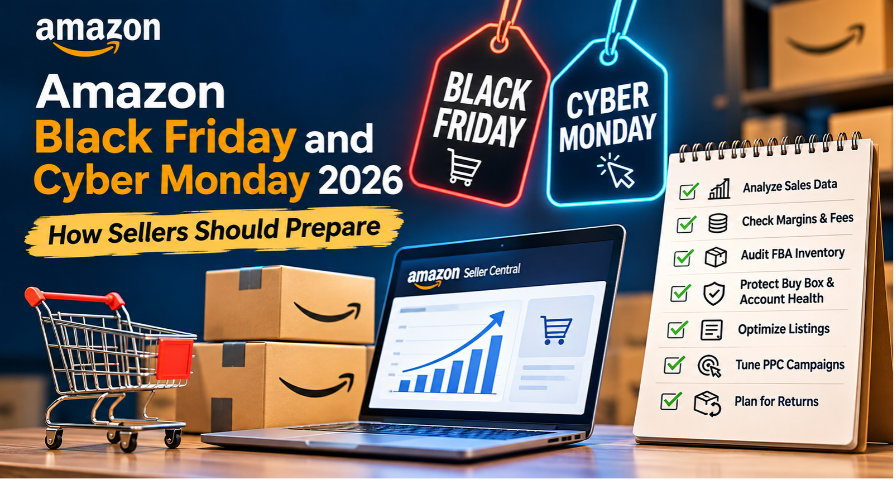
Black Friday is scheduled for November 27th, and Cyber Monday falls on November 30th. Unfortunately, for sellers at Amazon, high traffic means nothing without profits. They have more money for their ads and lower prices, but every single year they are still faced with out-of-stocks, rising advertising expenses, low conversion of listings, and additional fulfillment expenses they failed to predict. A successful strategy for Amazon Black Friday requires protection from lost profit, and with less than ten days left, the items that can succeed should be in stock, presented properly, and reasonably priced to maintain their position as a featured offer.
This guide offers the list of steps to take right now, according to their efficiency. Both private-label brand sellers and catalog managers who work with customers should make sure that all the possible errors are removed from their strategies prior to traffic spikes.
Start With Your Own Sales Data
Go to Seller Central and pull your Business Reports at the child ASIN level for the last 60 days, as well as last year's event days if available. Examine units ordered, sessions, and unit session percent per priority product. This way, you will understand the demand, the traffic needed to generate it, and the conversion rate of your listing. Avoid forecasting just based on last November. A product that has doubled its daily orders from last November will not act like the previous year's product, hence the need to consider the previous year's event lift plus current sales velocity and ad performance.
Know Your Margins Before You Discount
However, they appear to be competitive, but it all comes down to whether it makes mathematical sense. For each ASIN, compute the amount you earn after deducting the costs of goods sold, referral fees, FBA fees, marketing costs, and returns. In case your item earns 35 percent gross margin before marketing, you cannot possibly give the product a large coupon and pay money for marketing without losing money. Select the products you wish to put on sale and those you wish to sell at full price. Most people select one or two proven products with a discount tag and multipacks with higher margins to increase order value.
It is also worth reviewing your fulfillment fees. Amazon peak holiday fulfillment fees will start to take effect between October 15, 2026, and January 14, 2027. They will apply at the time you ship the order; thus, you may be working with higher margins than during your event sales. Review your promotions in the Revenue Calculator or fee preview reports.
Moreover, see whether you have promotions in place at the right time. There is a time limit for the promotions because the booking process for the promotional spaces starts months in advance. As a result, all the approved promotions must be up and running within their relevant time period according to Amazon guidelines of promotion pricing. In case you haven’t made a promotion yet, then even a good listing promotion or coupon would do the job. All promotions should be kept on record because even a single mistake in pricing or a day delay in the usage of coupon would ruin all your efforts of a week.
Audit FBA Inventory at the Child ASIN Level
Stock-outs are the least obvious way to fail to capitalize on the opportunities of Black Friday. Get your FBA inventory report and divide the list into the available inventory, allocated one, in transit, or stranded, because only the available goods can be sold during the peak week. All three suggested delivery dates from Amazon for this kind of event (October 14 for AWD, October 21 for minimum shipment splits, and October 28 for Amazon-optimized splits) have passed already hence, it makes no sense for you to develop your strategy on the goods in transit. Check whether the goods in transit have arrived and fix the problems with stranded inventory.
Calculate inventory coverage for each child ASIN, not just each parent. Divide units in inventory by average daily sales. For example, if you carry 600 units and your average daily sales are 30 units, you have 20 days of inventory coverage; however, during the Black Friday weekend, your velocity doubles, leaving only 10 days of inventory. The greatest importance lies in managing product variants. You could have an adequately stocked parent for socks, but the 10 to 13 size variant, which is the highest-selling one, might be close to out of stock, while the 9 to 11 and 13 to 15 size variants might still be sitting unused. Identify your high-selling variants and manage their inventories accordingly. Avoid investing money into advertising those variants that will not be able to fulfill the order volumes created by them. If you handle some fulfillment yourself, make sure that your merchant fulfillment stock, packaging capability, and handling times will survive the surge.
Protect Your Buy Box and Account Health
The Featured Offer is an essential factor in a lot of competitive Amazon listings. As a result, a product that is in high demand and has plenty of inventory may fail to sell because you did not get the Featured Offer. Price is just one factor. You should take into consideration fulfillment performance, account health, inventory availability, and offer health. Lowering your price is not enough. If you do not own a private label, then you should pay attention to competitors' offers and to their seller performance and the portion of the featured offer.
On the other hand, check your Account Health dashboard for suppression notices, restricted product notifications, and any policy violations. Just imagine spending $500 a day on advertising and then finding out that your primary listing was suppressed. Yes, it could happen. In addition, it is cheaper to find out about it this week rather than Friday morning. That is why you do not make big changes to your listing just before the event. Rewriting the title and restructuring variations can cause problems in the catalog exactly when you need everything to be perfect.
Strengthen Listings Using Customer Feedback
Once the shopper hits your Amazon listing, go back to your feedback and find out what your customers have been saying. Look at recent feedback, questions, and returns for each of your ASINs and see what issues they have raised. If customers are consistently saying that a particular sock variant is too small, then make sure that the sizing information stands out in the pictures, bullet points, and A+ section of your listing. Good lifestyle pictures, comparisons, and a quick video help eliminate doubt from the shopper's mind.
Watch Competitors, but Do Not Copy Them
Analyze your competition for an hour for their pricing, coupons, badges, ratings, and inventory. The chances are that three of your competitors might be doing a 15% discount and you stick to your price and don’t budge, then there will be no conversions. But you should not always match your competitors’ prices; you have to analyze your product quality, reviews, and margin before doing so. You can get away with less discount when you have better reviews and images of the product.
Prepare Amazon PPC Campaigns With Clear Priorities
AmAmazon PPC optimization is the place where the bulk of profit is either won or lost during this event. Instead of increasing budgets of all campaigns equally, it’s better to start with analyzing the efficiency of campaigns individually. Divide profitable campaigns from unprofitable ones and invest additional funds in profitable campaigns. Consider placements separately, too, because Top of Search, Rest of Search, and Product Pages can be very different, and it doesn’t mean that increased investment in top placement will increase the profit. It’s important to make sure that each promoted product has enough stock this directly leads us to children's ASINs again.
Maintain a list of a few metrics that will be visible to you: ACOS, TACOS, CPC, click-through rate, and conversion rate. ACOS gives you an insight into the efficiency of your ads from the perspective of the sales they generate, whereas TACOS measures your advertising cost in terms of your total sales, whether it is organic or paid. A high ACOS on Black Friday does not necessarily mean that you have made a poor effort in terms of advertising because your CPC gets increased due to the increase in competition. Let’s say there is one campaign with 28 percent ACOS and the other with 52 percent ACOS with similar margins and inventory.
These three practices will be very useful. First, keep an eye on budget pacing so that your best campaigns don’t become starved of clicks before the peak shopping time. Second, use the latest search term reports to confirm the converting search terms and to eliminate the traffic that doesn’t convert. Third, bid incrementally on conversion rates, CPC, placement performance, and profit rather than bidding up just because your competitors are being aggressive.
Treat Black Friday and Cyber Monday as Two Events
The shopper behavior changes from one day to another, so you should analyze the data from the previous day before finalizing your budget and price for the other day. During the event, you should keep track of the business reports, the advertising console, and the stock on a regular basis throughout the day, and it is important that there should be some decision in advance about the person responsible for stopping the campaign, changing the price, and removing the offer.
Plan for Returns and Review What Worked
There are different types of return patterns depending on the category, so it would be wise to study the reasons behind the returns by ASIN and identify any product lines that have continuous issues. There might be returns due to sizing problems for clothing sellers, while for electronics, it could be due to compatibility issues. When the events are over, evaluate each ASIN, offer, and campaign based on profitability after taking into consideration returns, marketing expenses, and any discounts, and record what needs to be changed next year while it is still fresh.
Final Thoughts
Those that benefit most from Black Friday and Cyber Monday are certainly not those with the best deals. They are those who know their margins, safeguarded their best-selling SKUs from being out of stock, had healthy accounts and listings, and advertised when it paid off. There are now only days to go before the big day, but you simply don’t have time to get all your ducks in order, so just focus on the two or three things you are most vulnerable at and get those done. Make sure you sell profitably.
Ready to Grow on Amazon?
Let our experts help you scale your Amazon business with proven strategies.
Get a Free Consultation
Comments (0)
Leave a Comment