Amazon Black Friday 2026: 5 Critical Dates and Costly Mistakes Sellers Can’t Ignore
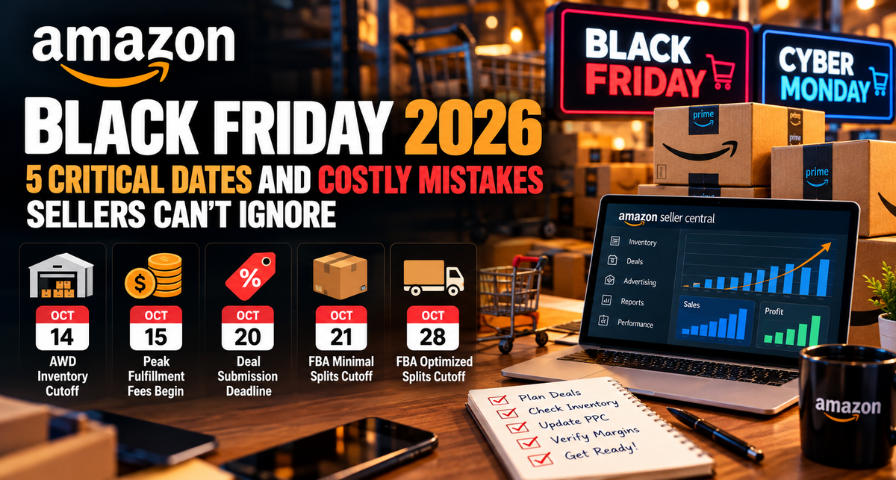
Black Friday falls on the 27th of November, while Cyber Monday is on the 30th of November, but there are a few decisions that need to be made within the next eight days, which will have a direct bearing on the success of your Amazon Black Friday 2026 campaign. This is October 12.
In this piece, we look at the five most important dates and the mistake that each one brings along. We will also look at an example for both profits and advertising so that you can run the numbers on your own. The examples here are purely illustrative and are not the rates used by Amazon.
The Five Critical Dates and the Mistake Each One Invites
October 14 is an inventory arrival cutoff for Amazon Warehousing and Distribution (AWD). Should you miss this date, it means that the respective stock will not arrive to the customers in time in accordance with Prime requirements for the event, so check out now whether your AWD stock has arrived already. October 15 is not a deadline but rather a fee change date from this day, holiday peak fulfillment fees apply. Sellers who neglect this date silently sacrifice their margins, so re-run the calculations prior to setting prices.
October 20 is the deal submission deadline: October 20, 2026, is the submission period for Black Friday and Cyber Monday deals. If you miss it, no deal badge will be applicable, so submit your deals several days in advance. October 21 and October 28 are the arrival cutoffs for FBA shipments with minimal splits and Amazon-optimized splits. Which one is relevant depends on the inbound options chosen when submitting the shipment.
The overarching mistake is planning these in isolation. Treat them as one chain: what you will discount, how many units that discount will move, and whether those units can physically arrive in time.
What Changed This Year, and What Still Needs Checking
The most useful change concerns pricing history. Amazon calculates a maximum deal price using 30-day and 60-day lookback periods, and a deep earlier promotion would normally lower that ceiling. This year, promotional prices offered during Prime Big Deal Days are excluded from those lookback periods. Sellers who ran sharp promotions on October 6 and 7 are not automatically penalized in November.
But don’t get that confused as being a guarantee. This is due to the fact that this will affect the way the ceiling is figured out, not the product and discount that you can use, so be sure to look at the maximum price in the Deals dashboard for each ASIN. Another thing to keep in mind is the absence of the $50 early-submission discount, which is because sellers had to have submitted their Black Friday Week and Cyber Monday deals by September 5 in order to qualify for it.
Pricing Your Deals: A Worked Example
Whereas most sellers look at a deal based on income, the better criterion is contribution margin. Consider a product that has a regular sale price of $30. The landed cost is $9, the referral fee is 15% or $4.50, the fulfillment costs (including peak pricing) are $6.50, and the advertising costs $4 per item. Contribution margin is $6.00 per unit.
With the 20% discount, the price goes down to $24. The referral fee becomes $3.60, while other expenses remain the same, resulting in an income of only $0.90 per unit. Consider that this deal will sell 400 units, while the normal sale is 100 units over the same period. The income will increase from $3,000 to $9,600, but the contribution margin will be $360 less $100 for promotion or $260 versus $600 for the regular income. To equalize the latter, you need to sell about 780 units.
This is contribution profit on the basis of the given conditions, but not the net profit, because storage costs, returns, overheads, and taxes have not been considered here. None of the above is intended to say that you should shun such deals. It might be a sensible business decision where a deal is done on the grounds of building ranking, repeat customers, or disposing of old inventory. The idea is to make an informed decision and then treat it as expenditure on advertisement.
Amazon FBA Inventory Planning: Arrival Is Not Dispatch
Inventory cut-off dates are the arrival dates at Amazon’s distribution centers; however, the dates are not shipping deadlines. Between delivery from the supplier and a checked-in inventory, there is time spent in transport, clearing customs if the inventory is imported, preparation, and receipt of inventory. Each of these processes can take days beyond what the published cut-off date allows for. In actuality, your own deadline is before Amazon’s deadline, and where the inventory is currently held (a port or at the supplier) could already be past your deadline.
Fulfillment centers’ capacity is another factor. Amazon has advised that fulfillment centers begin to process orders rather than receive inventory in November and December, leading to a situation where sellers face limited capacity constraints due to the holiday rush. The most effective solution is to make sure that the deals you make take into account inventory that will actually be available. A smaller order at a slightly higher price will be better than a large discount that will be impossible to deliver.
How Peak Fulfillment Fees Change Your Margins
The peak fulfillment fees are levied against qualifying customers' orders delivered through Amazon's fulfillment centers starting from October 15, 2026, and ending on January 14, 2027. Fulfillment fees are applied based on order delivery dates, and therefore, orders that go out on or after October 15 will have peak fees. The current 3.5% fee for fuel and logistics still applies to these fees.
According to Amazon, the increase is similar to 2025, with an average fee of $0.32 per unit. View this average as an estimate and not a promise. The fee varies according to size tiers and the fulfillment method. Get the actual number for your top-selling products using the Revenue Calculator and redo your margins. Note that the period ends on January 14, not December 31.
Amazon PPC Strategy: A Simple Decision Framework
A campaign without advertising cannot be compared to a store offering discounts without a sign outside, but increased budgets don't necessarily mean better investments. The basic requirements for creating an effective Amazon PPC campaign include four numbers: budget, attributed sales, conversion rate, and the amount of stock you can afford.
Let's assume that we have a campaign where the weekly budget was $500, the number of clicks was 250 ($2.00 per click), resulting in 50 orders with the cost of $2,000. This means that the conversion rate is 20 percent and the ACOS rate is 25 percent. In case the product margin before the ad costs is 35 percent, this campaign has ten points of safety and can easily handle extra budget. But what about the stock? In case you have two weeks of coverage, doubling the budget is safe. But in case you have only four days of coverage for the event, extra budget will just help you deplete your stock faster.
So raise the budget only if the ACOS is below breakeven and the inventory is enough to take care of the additional orders required for the entire event. Clicks costs will increase as we approach Black Friday, which increases the ACOS ratio, so we have a margin of safety. Make use of your reports for the Prime Big Deal Days to shift budget to the converting keywords, along with protecting your branded keywords.
Amazon Cyber Monday 2026: Pace the Whole Event
It is tempting to pour everything into Friday, but Amazon Cyber Monday 2026 extends the opportunity, and one submission covers both events. If your units and ad budget are gone by Friday night, you miss the weekend and a Monday audience that often skews toward shoppers who have been comparing prices for days. Watch Friday’s data closely. If a product converts well, shift spend toward it, and if it stalls, pull back before Monday.
A Quick Pre-Submission Check
Before submitting, run through the basics of Amazon highlights: check your Account Health Rating, resolve policy warnings, review deal health status, make sure deal-linked listings are active and meet quality requirements, and confirm your payment and tax settings are current. A suppressed listing or an expired tax interview can quietly remove a product from eligibility, so fix these early and leave time to respond to any flag.
The One Takeaway and Your Next Step
The single most crucial decision to be made regarding Black Friday is the amount you can deliver in a profitable manner. Prior to submission, check that your margin expectations are accurate, check your current stock situation, and have a cap on marketing expenditure. Dates and fees can be verified via Amazon’s peak readiness playbook for Q4 2026 (Seller Central login required) and at Supply Chain Dive’s coverage of 2026 holiday fulfillment fees.
Ready to Grow on Amazon?
Let our experts help you scale your Amazon business with proven strategies.
Get a Free Consultation