Amazon Algorithm and Ranking During Prime Big Deal Days: How Amazon Search Really Ranks Products
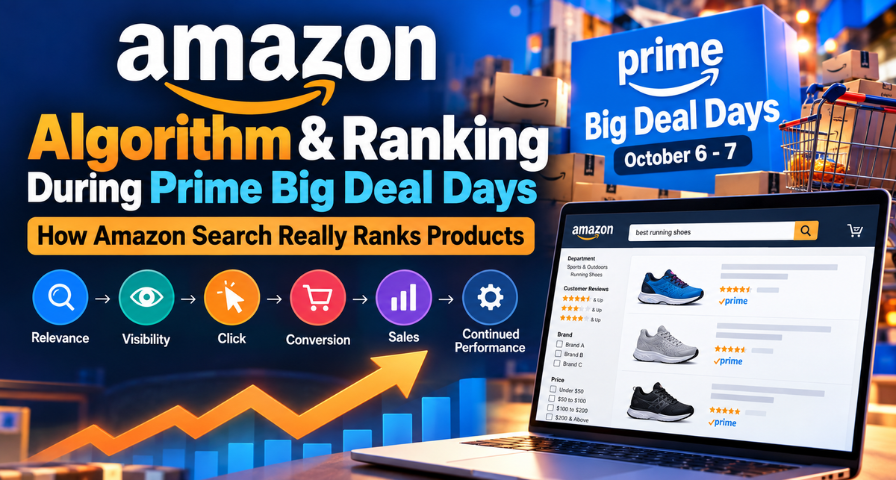
Each fall, Amazon hosts its annual membership sale, and this year’s Prime Big Deal Days will be 48 hours on October 6 and 7. From the consumer perspective, this is an opportunity to kick off the holiday list. From the seller’s perspective, this is an intense moment when years of listing efforts, advertising budgeting, and inventory management are tested in case of a sudden influx of traffic. The main question I receive in advance is something like "How to rank better during the event?" It seems to be easy, but the right way to give you an answer requires understanding the Amazon algorithm and its purpose.
The Amazon algorithm can be defined by understanding how Amazon search ranking takes into account relevance in relation to the real behavior of customers. This article will describe how this relationship works in practice, what happens during the event, what is new this year, and what can be done in the remaining time. There is one important notice beforehand Amazon doesn’t reveal the ranking formula of Amazon therefore, I'll distinguish between documented and widely observed data.
What the Amazon Algorithm Is Really Optimizing For
The trick is to stop thinking about Amazon search as a ranking game and begin thinking of it as a process designed to show the right, best-fit product. When a shopper searches, finds the product he wants, and buys it, that's a great result for Amazon, so the whole system is oriented towards reducing the distance between the search and purchase.
This leads us to a valuable two-step framework. Relevance determines whether your product will get into the candidate pool for the given search term, and performance affects its position among those candidates. Relevance comes from your title, bullets, backend search terms, category, and product attributes this is the heart of Amazon SEO. Performance comes from how real customers react to your listing once it's in front of them. Your listing could match all the keywords and still not do well if it receives few clicks or sales from those clicks.
We will refer to this system as A9 or A10. These are unofficial nicknames, and nothing of the sort exists in Amazon's publicly available documentation. Amazon never reveals the weightings of individual ranking factors, so everything below about weightings should be regarded as a conceptual model.
A Simple Framework for Amazon Search Ranking
Amazon search ranking can be best understood as an interrelated chain: relevance, visibility, click, conversion, sales, and further performance. First, the customer enters a search query, then your product listing is relevant enough to appear, it is visible enough to be noticed by the customer, who clicks, is convinced to purchase on the page, the sale is made, and it all affects your listing’s future performance when the same queries are entered again. Failure of one element weakens the whole chain.
Prime Big Deal Days is not altering the chain but making the process much faster and the traffic through it bigger. There are more customers entering, quicker decision-making, and you will get the results of each of the elements almost instantly. That is why a weakness that is tolerable during an average week will become costly during the sale period.
The Amazon Ranking Factors Sellers Watch Most
Without asserting any kind of hierarchy, there are some consistent signals in seller testing and discussions. Among them, sales performance plays a significant role, especially when sales performance is associated with relevant search traffic and customer activity recently. Another signal is conversion performance because it indicates whether the traffic is converting to purchase. There can be two listings with the same amount of clicks, but those who have better conversions provide Amazon with better proof that their product meets customers' expectations.
To convert a purchase, you will have to put in place some rather basic actions such as using a quality main image, setting an appropriate price among competitors, providing honest feedback, and delivering a promise that fits the needs of customers. Being a Prime-eligible product helps as well because fast and free delivery reduces one of the reasons for customers to abandon purchases. Click-through rate is the first signal that will tell Amazon that your listing is what a customer is looking for. Also, reviews work as trust signals. Availability is the forgotten factor until you find out how important it is since it is the lack of availability that makes Amazon not send customers to your listing.
These Amazon ranking factors cannot be considered separately, as search relevance and consumer reaction are interlinked. A good title with an unsuitable customer leads to click-throughs but no conversions, and an excellent product with an ambiguous listing may never reach its potential audience.
Why Prime Big Deal Days Changes the Picture
Prime Big Deal Days squeezes a regular month's shopping activity into two days. Traffic levels may spike, intentions are high, and browsing is guided by deal badges, event pages, and carousels. Amazon also stated that there are three new deals added every day during the event. This makes consumers return throughout the whole event period. At Prime Big Deal Days, deal placements add new chances for discovery in addition to organic traffic and ads, and thus, promotion eligibility may have quite some effect on consumer exposure.
Fast collection of performance data is another factor you need to consider during Prime Big Deal Days. A product with an actual discount and conversions will help you increase sales quickly, while an impression-heavy listing, which fails to convert, may miss the opportunity.
Also, the aftermath of the event should be taken into account in advance. Strong sales at the event can potentially result in increased search performance after it, especially if sales are made based on relevant queries. However, this is not certain since search rankings change depending on competition, demand, pricing, and conversions. One thing is predictable running out of stock during the event will take weeks to recover.
What Has Changed This Year and Why It Matters
Some changes warrant highlighting. First, deals continue to become more sophisticated. Industry news reports that Amazon made an exclusive deal available to third-party sellers on August 31 as of the Prime Big Deal Days, Black Friday, and Cyber Monday, starting from 15% discounts. It means that Amazon assumes deep discounts for its major sales, which should be expected by sellers aiming for premium placement.
Second, good news awaits when it comes to preparation. Amazon states that promotional prices set during the October promotional event will not impact Amazon's deals' lookback period, so participation will not jeopardize deal placement during Black Friday and Cyber Monday. This addresses one of the concerns keeping some sellers out of the game, although different rules apply to each type of promotion, and sellers are advised to check them in Seller Central.
Third, discovery becomes more sophisticated. Amazon's new AI assistant, called Alexa for Shopping, will become the key to price tracking during the event. It means that accurate structured data about the product becomes increasingly important because AI-assisted buying requires understanding product attributes, specifications, pricing, and relevancy. Good marketing copy cannot compensate for inaccurate product data.
The scale issue cannot be overlooked either. As reported by Adobe, the amount spent on e-commerce during Cyber Monday 2025 totaled approximately 9.1 billion dollars, showing a 7.3% increase from the year before. There was definitely a lot of competition for that one-page ranking space.
Where Amazon PPC and Amazon SEO Meet
There is no world divided between Amazon PPC and organic. The ads will give you extra traffic, and when that traffic converts into sales, the sales can help the product to perform well from the perspective of those particular search terms. In Prime Big Deal Days, Amazon SEO and Amazon PPC should go hand in hand rather than be considered separately.
The guidelines for sellers for the promotion say to review your advertising campaigns and increase budgets for well-performing products before October 6. The pitfall is the fact that it is about general spending and not about precise spending. During the event, competition for popular keywords will grow, and the spending will do the same. Spending on ads can promote your good-performing listing, but it will not save your bad listing. It will just show it faster.
Before the event starts, find out which of your search terms have already brought the highest number of impressions, clicks, and orders. This is the traffic you will need extra of. Instead of distributing the budget for all keywords, use the event to protect your search terms that have proven to convert and ensure the budget lasts through peak hours.
What to Measure Before and During the Event
Evaluate your metrics through the lens of a funnel. In the Search Query Performance reports provided by Amazon for brand-registered sellers, you can get insights into the journey taken by your customers from impression to click to adding to cart to purchase with the help of particular search queries. Observing such trends might enable you to determine where exactly your funnel falls short. Low CTR despite high impressions would mean that there is something wrong with your product's title, picture, or price. Low cart additions despite clicks might mean that your product page is not convincing enough. Non-purchase after cart addition could be because of any concerns regarding the price or shipping of the product.
Practical Moves for the Days That Remain
With only a few days left until the event, the most useful thing one can do is quite often not very flashy. Firstly, check your inventory, because nothing kills a good performance like running out during the peak. Make sure that all your products are in the fulfillment centers and not on the way there, and try to evaluate if you might sell faster than usual.
Secondly, take a look at your listing from the buyer's perspective. Is the main image nice and correct? Is the first bullet point addressing the question your customers might have? Is your price after the discount competitive among the three or four closest sellers? Small adjustments to your title and images will have more impact on your conversion than spending extra money on ads.
Thirdly, concerning promotions, the deadline for the Best Deals and Lightning Deals is mentioned to be September 22; however, the coupons can be used during the whole event, and Prime Exclusive Discounts can be submitted even 12 hours before its end. And finally, make sure to maintain your reputation signals.
Common Misunderstandings Worth Dropping
There are some misconceptions that can cause more trouble than anything else. For instance, making forced jumps through artificial prompts and incentivized reviews not only breaks the rules of Amazon but is counterproductive because of how post-click behavior like returns and negative reviews shows the trick. The next misconception is that bigger discounts are better, while a discount may actually help only if it will increase conversion and does not affect the margin in a negative way. Finally, there is the belief that the algorithm knows some kind of hidden trick. In reality, the sellers that succeed just do boring work reliably: listing, inventory, prices, advertising.
Key Takeaways and What to Do Next
The one take-away that I hope you have from this article is that the Amazon algorithm is more accurately thought of as a mirror of consumer behavior than as some puzzle to be figured out and exploited. During Prime Big Deal Days, that mirror just becomes louder and faster.
The changes made this year all send the same message. There is now a greater formalization of deal expectations, promotional pricing for the event seems to be excluded from the deal lookback window, and AI-assisted shopping favors listings that are cleaner and based on facts. This does not require any dramatic shift in your strategy; it just requires more efficient execution.
So do yourself a favor and conduct a short audit today. Check your stock levels, review your top listings, get enough funding for your top converting ads to last throughout the peak period, and come up with a plan for what you are going to do if something starts moving faster than anticipated. Using October as an educational experience, rather than merely a sales period, gives you some valuable information for November.
Ready to Grow on Amazon?
Let our experts help you scale your Amazon business with proven strategies.
Get a Free Consultation