Amazon AHR Update: How Customer Service Can Now Boost FBM Seller Accounts
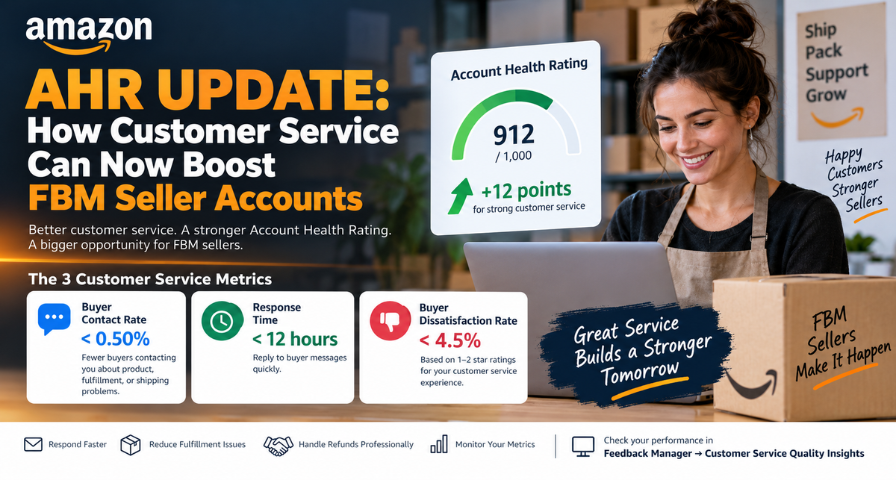
If you are an FBM (Fulfilled By Merchant) seller on Amazon, you will notice one change that is worth implementing in your selling process. The company has adjusted the way its Account Health Rating (AHR) system works, allowing the merchants to earn additional AHR points for good customer service practices. This update is not just another technical addition hidden in policy changes that nobody pays attention to. It represents a new approach to measuring performance for those who fulfill their own orders without FBA (Fulfillment by Amazon).
As for account health rating, this concept was originally based on such factors as policy compliance, order defect rate, and shipment performance. The role of customer service was rather symbolic since it could not be seen as affecting this rating. However, everything has changed, and the sellers fulfilling orders themselves are able to earn up to 12 additional AHR points depending on three particular customer service metrics. If you have regarded customer service as secondary before and responded to complaints from the buyers reactively, this update can help you to reconsider your strategy.
What Amazon Actually Changed
This latest update introduces an additional dimension to the Account Health Rating process, which is based solely on the post-purchase experience. Rather than assessing only such things as defects and delays in shipments, Amazon will include in their evaluation how quickly and effectively you respond to the customers' needs. The need for such a change was quite obvious, considering the long-existing gap in the process, the post-purchase experience has always been largely dependent on the seller in the case of FBM orders, while FBA orders enjoy the fact that Amazon takes most of that shipping hassle onto itself.
The Three Metrics That Now Influence Your Score
The new point system is built around three customer service indicators, and each one captures a different part of the buyer's experience.
Firstly, it's the buyer contact rate, where Amazon hopes for a contact rate lower than 0.50 percent. The buyer contact rate shows how often buyers contact due to problems associated with the product itself, the fulfillment, or the shipping of the order. A low contact rate indicates that the orders are being delivered without any problems. It is necessary to understand that we aren’t trying to discourage buyers from contacting you at all but rather minimize the number of issues raised by buyers.
The second metric is response time, with Amazon looking for replies within 12 hours. This one is simple in concept but easy to underestimate in practice. Buyers who message with a question or concern want to feel heard quickly, especially if there's an issue with something they've already paid for. A 12-hour window is reasonable, but it does require some kind of system, whether that's checking messages multiple times a day or setting up alerts, rather than logging in once every couple of days.
The final measure is the buyer dissatisfaction rate and must be kept below 4.5%. This is calculated according to the one- and two-star ratings received from buyers in relation to their experience with the customer support team. It focuses more on the way the problem was resolved rather than the fact that there was a problem with the product itself. For example, a buyer may have a problem with their order being delivered late but still rate their experience highly if communication was good.
Why This Isn't a Penalty System
Amazon has framed this as an opportunity, not a new way to get penalized. Poor performance on these three metrics won't restrict selling privileges, and by design, the feature is only meant to move Account Health Rating upward, not down. If you're relying on this for a specific launch or compliance decision, it's worth confirming the current wordingIt is safe to say that Amazon considers this as an opportunity rather than another way of getting penalized. Poor performance on these three indicators will not affect your ability to sell products; moreover, this tool should be aimed exclusively at raising your Account Health Rating and not bringing it down. In case you are considering using it for a particular launch or compliance issue, it is recommended to double-check the exact wording that is used in the corresponding document on Seller Central, as Amazon's documentation takes precedence when it comes to the functioning of each particular indicator. According to the information provided so far, this can be treated as more of a bonus system rather than a potential risk: those who have been dealing with their customer service properly all along, or who are prepared to correct one or two mistakes in their work, will receive a boost.
That said, it's worth taking seriously rather than treating as optional. Account Health Rating plays an increasingly central role in how Amazon evaluates seller accounts, and a stronger score can support account standing and eligibility for certain programs over time. Passing up a way to improve that score, especially through practices most sellers should already be doing, isn't much of a strategic choice.
Why This Change Makes Sense (A Likely Read, Not an Official Explanation)
Amazon hasn't published detailed reasoning for why this update exists, so what follows is informed interpretation rather than something stated outright. Marketplace trust is Amazon's core asset, and buyers keep coming back largely because they trust that problems get resolved without much hassle.
Seller-fulfilled orders introduce more variability into that experience, simply because logistics are being managed independently rather than through Amazon's standardized network. Tying customer service performance to Account Health Rating looks like a way to nudge that segment of sellers toward the same consistency FBA orders tend to deliver.
If that reading is right, it's a case where Amazon's incentive and the seller's long-term interest point in the same direction. A smoother buyer experience tends to produce better reviews and fewer disputes regardless of what Amazon measures, so the metrics aren't asking anyone to do something outside good business practice. They're just making that practice visible and rewarded.
It also fits a broader pattern in how Amazon has been evolving its performance standards, with more weight going toward buyer sentiment and communication quality alongside the traditional operational numbers.
What Sellers Should Actually Do
Knowing the metrics matters less than acting on them. Start with response speed. If your current habit is checking messages once a day or less, that needs to change, since the 12-hour window applies regardless of weekends or holidays. Reminders, mobile notifications, or assigning someone specifically to monitor buyer messages can make a real difference here.
Knowing the measures does not help as much as taking action on them. Let's begin with response time. If you currently have a tendency to respond to emails once a day or even less frequently than that, you definitely need to change that since there is the 12-hour limit, no matter whether it is a working day or a weekend/holiday.
Another issue to consider is refund and replacement requests. Customers tend to be extremely understanding regarding the problems if a seller is honest about them and ready to work on solving these issues. Do not postpone decision-making or make buyers go through several rounds of explanations to receive proper assistance from you. It will help prevent negative feedback from customer service even in cases when the problem occurred due to the situation that could not be controlled.
Finally, remember that you should check those metrics regularly rather than only in case something seems to be wrong. Amazon has helped sellers to make it possible by collecting that information into Feedback Manager under Customer Service Quality Insights.
Final Thoughts
This update gives merchants fulfilling their own orders a concrete way to turn everyday customer service work into a measurable account health advantage, and it does so without adding any new risk. Buyer Contact Rate, Response Time, and Buyer Dissatisfaction Rate aren't complicated to understand, but improving them consistently takes a bit of operational discipline. For sellers willing to put in that effort, the payoff is a stronger account health rating and a smoother buyer experience, two things that tend to reinforce each other over time. Checking Customer Service Quality Insights inside Feedback Manager is a good place to start seeing exactly where you stand today, and it's worth confirming the exact thresholds and point values against your own Seller Central dashboard, since Amazon can adjust these figures over time.
Ready to Grow on Amazon?
Let our experts help you scale your Amazon business with proven strategies.
Get a Free Consultation