Amazon Advertising Costs in 2026: CPC Benchmarks, ACoS Analysis & PPC Budget Planning
The Short Answer Most Sellers Are Looking For
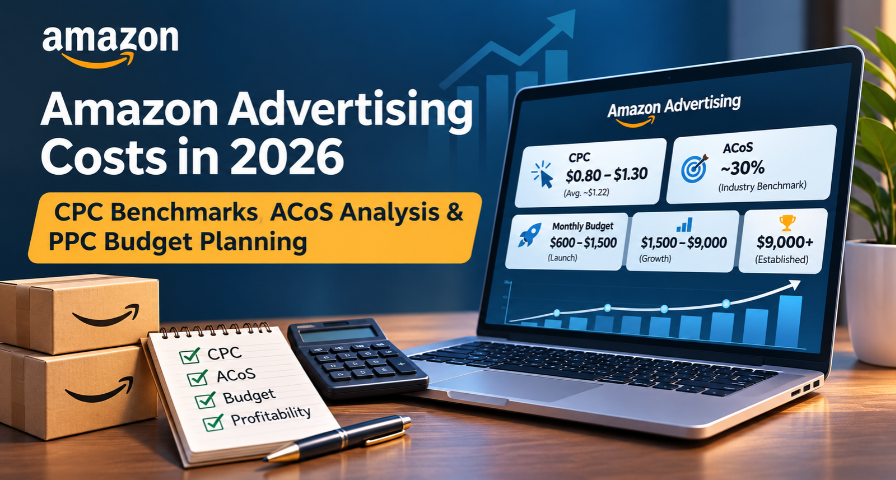
For Sponsored Products on Amazon in 2026, typical ad spend ranges from $0.80 to $1.30 per click, averaging at $1.22 with an ACoS (Advertising Cost of Sale) of 30%. These are industry averages and do not guarantee anything, as they depend entirely on the dataset used, reporting period, and category breakdown of data. As a rule of thumb, most brands invest about $600-$1,500 per month when launching their products on Amazon, $1,500 to $9,000 during the growth phase, and more than $9,000 after gaining stability.
Any researcher of Amazon PPC costs needs a number to know what to expect. At the same time, the number can often mislead, as one may think that the more expensive the cost-per-click rate is, the worse the situation is. A vendor with a CPC (cost per click) rate of $2.00 can be much more profitable than one having a $0.60 cost-per-click rate but being unprofitable in the overall picture.
What Factors Affect Amazon Advertising Costs
An Amazon ad campaign follows an auction process. The more advertisers are competing for their ads' display during a customer's search query, the more likely it is that you will need to outbid others based on your bid and other criteria, such as whether your ad qualifies for an auction at all, the ad placement, and the relevancy of your listing to the search. Even though relevance gives you an advantage, it does not always help reduce your CPC costs. CPC is a variable price influenced by competition and the relevance of keywords and listings.
The most critical factor is category. Competitive categories with a high margin, such as electronics, beauty products, or dietary supplements, are usually priced above average since there is an overabundance of advertisers fighting over scarce keywords. Categories that are underrepresented, including groceries or books, tend to be priced below average due to lower product value and competition. I did not include actual numbers for each category intentionally since any number should be mentioned only with the source.
The season should be taken into account too. During the fourth quarter, people purchase gifts, and the advertising budgets get larger, which causes the CPC to rise, after which it starts falling again during January. A product with good photos, decent reviews, and reasonable price has better conversion, and it determines the budget for bidding.
Amazon Advertising Cost by Campaign Type
Sponsored products are those keyword-based and product-based advertisements that come up in the search results or on the product pages. These advertisements get billed based on clicks, these are the most popular entry points, and these are also usually the cheapest way to drive quality traffic. Most of the metrics discussed in this article pertain to them.
The Sponsored Brands feature will display the logo, a headline, and a bunch of products. Again, these are billed based on clicks, but they do not aim at selling anything. Their main function is branding and the introduction of multiple products to the customer. Due to their high placement, they are usually more expensive per click.
Sponsored Display targets your audience within the platform and off-platform, including those who saw your product but didn't make a purchase. Depending on the type and optimizations that you select, it may be charged on a per-click or per-thousand viewable impressions (vCPM) basis, so you should consider the charging method when comparing it to other ad formats. Amazon DSP is another programmatic advertising solution charged mostly by the impression (CPM) metric and is best suited for more mature brands with higher budgets and awareness objectives. Determining the public prices of Amazon DSP is difficult due to a number of factors involved, and you shouldn't use a single price when planning your budget. To summarize, the first three types target direct sales, brand building, and retargeting, respectively, while DSP is aimed at reach. For most sellers, it's better to master Sponsored Products first.
Amazon Advertising CPC Benchmarks for 2026
With Sponsored Products, this year's range is approximately $0.80 to $1.30, and the average of around $1.22 serves as an approximate guideline to use when you review your campaigns' reports. But do not take it too seriously. A lower CPC does not necessarily mean that your bid is too low, and a CPC of $2.00 does not necessarily make it a waste. A $2.50 click on a product costing $90 with a high conversion can beat a $0.50 click on a product priced at $12, which seldom sells.
But the average CPC hides a very large range within every single account. Branded keywords with high conversion rates and low CPCs where consumers are actively searching for your product are one type and generic, highly searched but with low conversion rate keywords are the other. A good account always strikes the right balance between them.
Understanding ACoS and Why 30% Is Not a Target
ACoS = Ad spend / sales attributed to these ads. If you spent $300 in order to make $1,000, your ACoS is 30%. The value is cited so often that merchants use it as an ACoS target value, which is a huge error.
Your optimal ACoS value is defined only by your margins. For example, a product with 55% of margin prior to advertisement will be profitable if the ACoS value is 35%. But the product with a 25% margin cannot be profitable at 30% ACoS. You can see that two merchants with the same ACoS value may experience different financial results.
How to Calculate Your Amazon Break-Even ACoS
ACoS is a ratio of the total cost incurred for the ads compared to the revenue brought by these ads. An ad campaign that costs you $300 to make $1,000 in revenue makes an ACoS of 30%, a number that pops up in benchmarks so often that sellers end up using it as their target, which is wrong.
The right ACoS for your business depends entirely on your margins. A product that has a 55% pre-advertising margin can easily do an ACoS of 35% and make a profit, while one with a 25% margin is making losses when its ACoS is 30%.
Amazon Advertising Cost Calculator: Estimate Your CPC and Budget
The two formulas help transform these targets into realistic numbers. The first is Maximum CPC = Price x Target ACoS x Conversion Rate. With a price of $40, a target of 30%, and a conversion rate of 10%, this formula becomes $40 x 0.30 x 0.10 = $1.20. This can be viewed as a ceiling number based on certain assumptions about conversion and attribution rates, but not necessarily one where you are going to make money with your bids. In case conversion drops to 7%, we have the same formula equal to $0.84. When increased to 15%, it becomes $1.80.
The second equation is Monthly Budget = Target Ad Sales x Target ACoS. If you desire $4,000 of ad sales and have a 30% target ACoS, your budget should be $1,200 per month. This can be sanity checked by looking at it in the other direction. With a 10% conversion rate, 100 sales take 1,000 clicks. With the average CPC being $1.22, this would cost approximately $1,220, which is an ACoS of around 30.5%. With a break-even point of 40%, you have some room to work with when growing your business. With a break-even of 28%, you would lose money.
How Dynamic Bidding and Placement Optimization Affect Amazon PPC Costs
There are three bidding types offered by Amazon. Dynamic bid down only sees Amazon reducing your bid when it considers the click not too likely to convert and not increasing it under any circumstances, thus being a good choice for those who prefer strict control over bids. Dynamic bid up and down allows Amazon to increase your bid when it thinks that the click is more likely to convert, resulting in better sales performance but potentially increasing your CPC as well. Fixed bids do not change under any circumstance, providing reliability but ignoring important signs that could help save or make you money.
Placement is yet another factor. Top of Search is the top spot above the regular results, Rest of Search includes lower results and subsequent pages, and Product Pages is where you place an advertisement on detail pages, usually along with competing products. A keyword will act completely different depending on the placement you chose. One particular keyword may generate sales through Top of Search and waste money through Product Pages, where customers are comparing products already. Increasing a placement modifier will increase your bid every time it gets used, and that’s why you should evaluate placements based on their impressions, clicks, CPC, orders, conversion rates, and ACoS before increasing the modifier.
How Much Should You Budget for Your Amazon PPC Budget?
Budgets normally align with the product's life cycle. Initially, budget spends usually fall in the $600 to $1,500 bracket. Here, the target is to gather data rather than optimize, meaning that there will be enough clicks to know what terms to convert for creating sales velocity and generating reviews. ACoS normally remains high at this stage and this is okay because here we see an investment with a fixed expiration date.
As we move to growth stage, most brands usually spend between $1,500 and $9,000. We have winning keywords and good experience, and now the main thing is to scale the campaigns and protect them. For established brands, the budget spend may go beyond $9,000. Now, advertisements become a core of the business, and the focus moves from ACoS to profitability.
The first thing that confuses many sellers is that a daily budget does not equal the real spending in the month. Amazon will spend more on some days than the daily budget, while on other days they may spend less. For details about Amazon’s budget policy, you should check with Amazon. It’s important to note that there is no requirement for each keyword to get a certain number of clicks a day.
What TACoS Tells You About Advertising Performance
ACoS considers the ad-attributed sales alone. In contrast, TACoS considers the ratio between ad spend and total sales, whether organic or not. A seller who has an ACoS of 35% and a TACoS of 9% might be doing better than one whose ACoS is 22% and TACoS is 20%.
But there is a need to exercise some caution. While a decreasing TACoS may signal that your ads are fueling organic growth, it doesn’t necessarily mean that because your organic sales could be increasing because of seasonality, price changes, or promotion. Consider organic sales, ranking of your keywords, and contribution profit together with TACoS. Correlation doesn’t equal causation.
How Inventory Availability Affects PPC Spending
Advertising needs to be measured in the context of stock as well. For example, what if an advertising campaign is performing nicely but there are only 50 units left in stock. This will only lead to an earlier stock out, causing problems for your listing and your ranking along with the money wasted on earning it.
Make sure that your advertising budget matches the stock, replenishment lead time, and seasonal trends. In case of long lead times, decrease your budget. Also, before entering into a peak season make sure you have enough stock to go with it. For those sellers who have multiple products, you need to check stock along with their campaigns as well.
How to Reduce Amazon PPC Costs Without Losing Sales
Begin by performing keyword harvesting. Automatic and broad match campaigns show the true search terms shoppers use, and the keywords with conversions can then be placed into exact match campaigns where bids can be more precisely managed. Discovery campaigns discover, and exact campaigns scale.
Combine this with negative keyword management, and make your judgment. For example, one search term costs $100 and gives no orders, while the other spends $80 and makes four orders. With a price of $40 per order, the latter keyword brings $160 and has the ACoS of 50%, which is more than 40% needed to break even in our previous example. Such a keyword needs more attention for bids and conversion analysis, while the former one requires research on relevancy and listing optimization, among others. At a CPC of $1.20, $100 brings 83 clicks, and if the conversion is 10%, eight orders should have been made, but none were made, which means a red flag. It will not be in case of very low click-through rates, of course. Do not pause all the keywords without sales immediately.
Moreover, consider the balance that you use between discovery campaigns, exact match campaigns, branded targeting, and product targeting. The cost per click of branded terms is low and very high-conversion, whereas that of generic terms is high because they provide you with fresh customers; thus, a good account will have the former subsidizing the latter. Incremental change compounding occurs quicker than drastic change, and increasing the listing conversion rate will improve your efficiency without bidding.
Amazon PPC Management Costs
When outsourcing your campaigns, remember that there will be additional costs to the budget in terms of payment for the services of the outsourcing company. The most typical billing structures are based on percentage of spend and can go from 10% to 20%. There are flat rate structures with a set amount charged per month. Depending on the level of work involved, account size, and other factors, expect the figures to change. With $3,000 of spend, the 15% rate brings an extra $450, making the total cost $3,450.
The percentage rate model means that the revenue of the outsourcing company will depend on your spending budget, which might result in spending more than you should. This is why flat rate pricing model suits bigger accounts better and more predictable budget-wise. Be ready to evaluate the value of the service regardless of the cost.
Common Amazon Advertising Budgeting Mistakes
The first major issue that comes up frequently is the lack of a break-even point, making all your advertising efforts nothing more than a shot in the dark. A very close second is growing too quickly without proper conversion data to justify increasing your budgets. Too many sellers focus on CPC instead of their conversion rate.
One other common mistake is having a single ACoS target for all their products. High margin and low margin products should have their own ACoS targets to know which campaigns work and which don’t. Lastly, sellers often forget about their inventory and continue to spend money while their stock is dwindling down.
Frequently Asked Questions
What is the average Amazon PPC cost per click in 2026?
For Sponsored Products, a typical range is about $0.80 to $1.30, with a blended figure near $1.22. Your own number depends on category, competition, season, and listing quality, so use the benchmark as a sanity check rather than a target.
How much should a new Amazon seller spend on PPC?
Many launches fall between $600 and $1,500 a month, but this is a planning range. Build your figure from the sales you want, your expected conversion rate, and your likely CPC.
What is a good ACoS for Amazon advertising?
A good ACoS is one below your break-even. If your margin before ads is 40%, a 30% ACoS leaves room for profit, while the same result loses money on a product with a 28% break-even.
What is the difference between ACoS and TACoS?
ACoS divides ad spend by ad-attributed sales. TACoS divides ad spend by total sales, including organic. TACoS shows how advertising fits into the whole business, though a lower figure does not prove ads caused organic growth.
Does Amazon charge for impressions or clicks?
It depends on the format. Sponsored Products and Sponsored Brands are billed per click, Sponsored Display can be billed per click or per thousand viewable impressions, and Amazon DSP is primarily billed on impressions.
How can I reduce Amazon PPC costs?
Add negative keywords, move converting terms into exact-match campaigns, review placement performance before raising modifiers, and improve listing conversion. Each lowers your cost per sale without simply cutting bids.
Does increasing bids always increase sales?
No. Higher bids can win more impressions and better placements, but if conversion stays the same, you may just pay more per sale. Raise bids only where your numbers show room under your target ACoS.
Final Takeaways
Amazon advertising cost in 2026 is best understood as a ratio rather than a price tag. The benchmarks show where the middle of the market sits, but they cannot tell you whether your campaigns are healthy. Only your own margins can.
Before you increase any budget, calculate your break-even ACoS, review your search term reports for wasted spend and promising terms, and compare your ad performance with the inventory you actually have on hand. Track TACoS next to ACoS, and treat any management fee as one more line in the equation. Do that, and the question shifts from “how much does it cost?” to the far more useful “how much profit does each ad dollar bring back?”
Ready to Grow on Amazon?
Let our experts help you scale your Amazon business with proven strategies.
Get a Free Consultation
Comments (0)
Leave a Comment