Amazon Ads Payment Changes: How the New Billing Policy Affects Seller Cash Flow
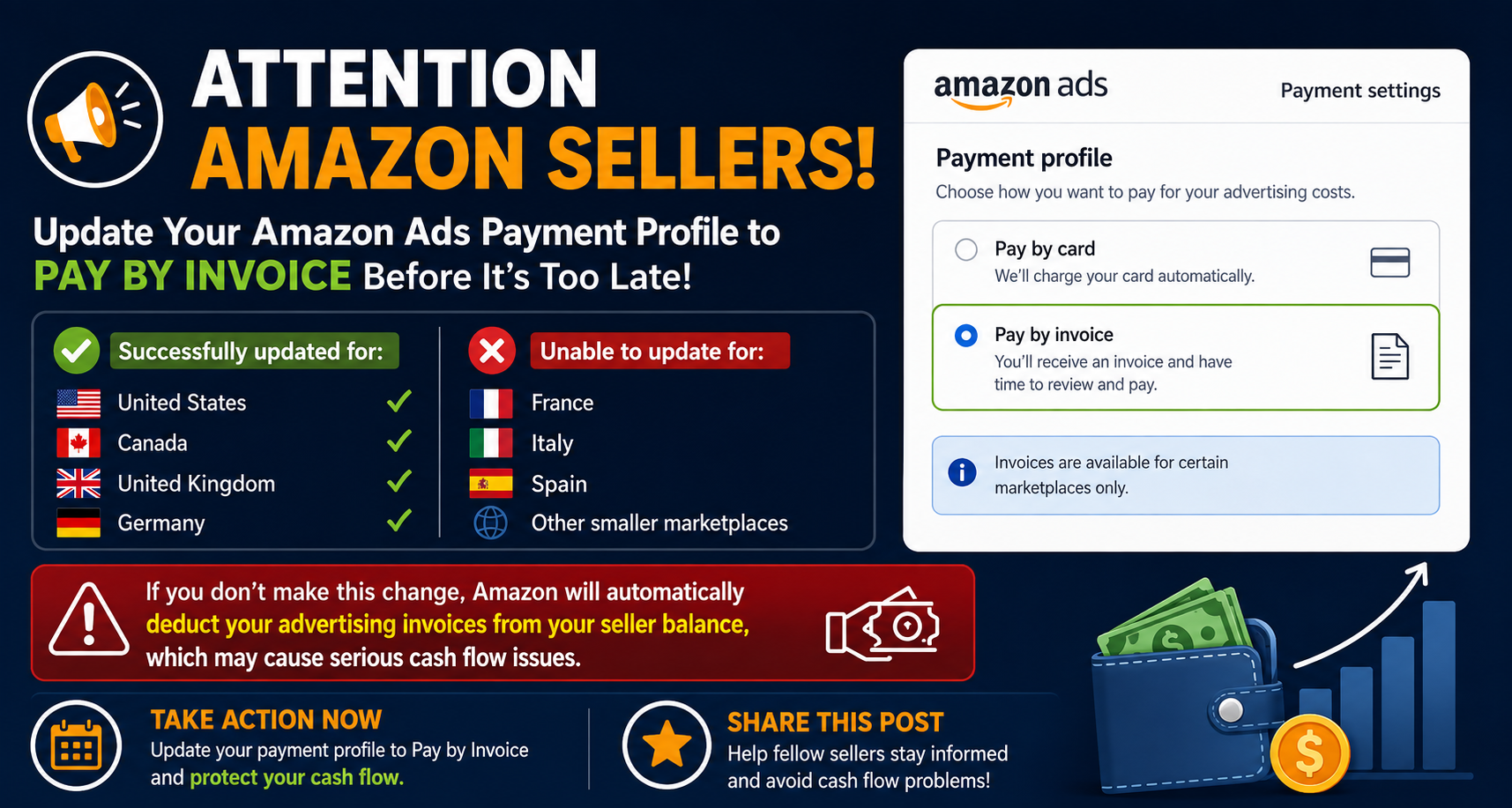
For those who advertise on Amazon, you will have likely noticed that there is a change in terms of how they bill you. Payment changes on Amazon Ads have started for some advertisers, and it does make an impact on cash flow management. They are discontinuing credit card billing for a select few advertisers as of August 1, 2026, and instead, the billing will be done through deduction from the seller/vendor account or choosing to go with Pay by Invoice. This is particularly significant for those sellers who have been using credit cards to extend the time between spending on ads and when the actual cash leaves their account.
What Is Changing in Amazon Ads Billing
It should be noted that Amazon considers it an update of the available payment options for eligible advertisers, who would move towards payment from the balance of their seller or vendor account or using Pay by Invoice. Such a move is not a universal solution adopted for all sellers on the marketplace. It has been clarified that this change is only applicable to eligible advertisers, and not every seller account, which is the reason why some sellers see this message about the new billing option in their accounts or in emails from Amazon, while others do not notice anything out of the ordinary.
For eligible accounts, credit cards don't disappear entirely. Instead, they remain on file as a backup payment method. If the available seller balance isn't enough to cover advertising costs, Amazon charges the card automatically. That's a meaningful shift, because the card moves from being your primary payment method to a fallback that only kicks in when your balance falls short.
Let's look at how it can work in practice. Assume that your account generates 40 thousand dollars in sales during a certain payout period and you pay 8 thousand dollars for Amazon Ads during that period. With the new billing model, Amazon will first deduct the eligible advertising cost from the proceeds of your seller account before transferring the remaining amount to your bank account. Therefore, even though the sales number may look good, you will have less money available for purchasing inventory, covering payroll, etc.
Why Amazon Delayed the Rollout
This change did not happen without pushback from the seller community. Amazon originally notified advertisers that credit card billing for ad fees would end and shift to deduction from earnings starting April 15, 2026. After hearing feedback from advertisers, Amazon adjusted course and deferred the change until August 1, 2026, specifically to give the affected group of advertisers more time to prepare.
Those are all the details that Amazon has officially shared regarding the delay. With three-and-a-half months to account for, it gave the sellers an opportunity to calculate their cash flows, discuss extended payment terms with the suppliers, and determine if Pay by Invoice suited them.
The Pay by Invoice Alternative
Fortunately for Amazon's merchants, Amazon hasn't forced all those impacted advertisers to go with the automatic proceeds deduction approach. There is the opportunity to go with Pay by Invoice on the Ads Console billing page. As per this process, you get a monthly invoice and have 30 days to pay it off. 30 days may not be the equivalent of a credit card billing cycle, but it sure is far better than being immediately deducted from your seller balance.
Changing to this approach is simple but must be done before the deadline hits. To do this, go to Ads Console, Billing, then Payment Method, and pick Pay by Invoice. It has to be done before the August 1st deadline, or else, by default, Amazon will update the default payment method to be a deduction from the available seller or vendor account balance.
However, one interesting bit of information comes from sellers who themselves have done this before. The availability of Pay by Invoice does not seem to be universal for all marketplaces. Some sellers have experienced smooth switching for accounts in the US, Canada, the UK, and Germany, but Pay by Invoice has seemed sporadic or not available at all for marketplaces like France, Italy, and Spain. If you have had a similar experience to this, it should be a reminder that your eligibility will depend on your individual account and the particular marketplace itself.
Why This Matters for Amazon Seller Cash Flow
It's tempting to treat this as a minor administrative update, but the cash flow implications can be significant depending on your monthly ad budget. For a seller spending around 15,000 dollars a month on advertising, the combined loss of credit card float and rewards has been estimated at several thousand dollars a year. That's not a rounding error for a seller operating on thin margins.
Layer this on top of other cost pressures many sellers are already navigating, from fulfillment surcharges to rising cost-per-click on competitive keywords, and the timing of cash movement becomes a bigger factor than it might first appear. A change like this doesn't just affect your ad budget line item. It can ripple into how much working capital you have available for restocking inventory or covering payroll in a given month.
What Sellers Should Do Now
If you haven't already checked your account, log into your Ads Console, go to Billing and Payments, and review your current Payment Profile before your next billing cycle. If Pay by Invoice is available and it suits how you manage cash flow, switching takes only a few minutes. If it's not currently showing as an option for a particular marketplace, check back periodically, since availability may expand over time.
Every seller's account, marketplace mix, and cash flow needs are different, so there's no single right answer here. Some sellers will prefer the predictability of proceeds deduction, since it ties advertising spend directly to sales performance without a manual step. For others, the added benefit of having 30 days to settle their payments via Pay by Invoice will come in handy, particularly if they have their accounts running in several marketplaces and other forms of receivables.
If you have your account impacted or otherwise, this update reminds us once more that operational settings are just as crucial as optimizing our campaigns. It only takes a minute or two to check your payment settings, after all. For others, the added benefit of having 30 days to settle their payments via Pay by Invoice will come in handy, particularly if they have their accounts running in several marketplaces and other forms of receivables.
If you have your account impacted or otherwise, this update reminds us once more that operational settings are just as crucial as optimizing our campaigns. It only takes a minute or two to check your payment settings, after all.
Ready to Grow on Amazon?
Let our experts help you scale your Amazon business with proven strategies.
Get a Free Consultation