Amazon Account Health Is More Than a Warning System
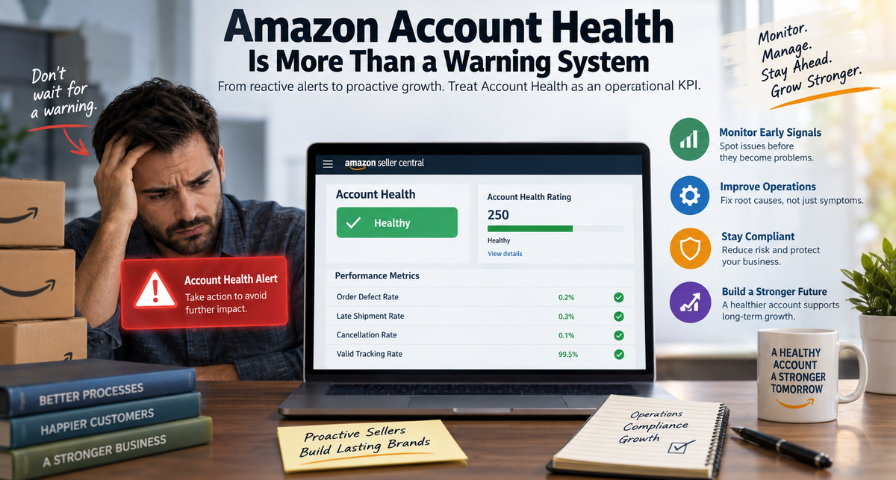
However, most Amazon sellers do not check the Account Health page until some problem pops up. A notification shows up, something goes red, and a rush to figure out what happened and how it can be addressed to save a business starts. It is natural for people to act this way, but it is also an indication of a lack of understanding of what Amazon Account Health is about. Amazon Account Health does not have anything to do with just ticking a compliance box or having an alerting system, which needs to be looked at only when it becomes active. It is an indicator of the state of the operational side of the business, which deserves as much attention as revenue, margin, or inventory turnover of the company. To neglect it and pay attention to it only when a notification comes up is similar to waiting until a car breaks down to check if something goes wrong under its hood. The better way of using the tool, the way that is gaining ground among both experienced sellers and agencies, is to consider it as a real KPI.
There is actually a more accurate way of phrasing that other than “keep an eye on your dashboard.” When looking at account health, which is what Amazon tracks and reports, it is considered to be a lagging indicator. If there has been any change in a statistic such as the order defect rate, whatever led to that change labeling issues, poor customer service, or an incorrect product size sent by the supplier has already taken place. The critical thing is not just to keep a closer watch on the score itself but on the operational indicators of where it’s going.
What Account Health Actually Measures
The Amazon Account Health system is a combination of performance metrics that show how the seller cares about their clients, what their policy adherence record looks like and how they handle order fulfillment. Metrics include Order Defect Rate (ODR), late shipment rate, cancellation rate, valid tracking rate, and multiple policy compliance flags related to Intellectual Property, Authenticity, and Restricted Content policies. Now, for a lot of sellers, a lot of information is reflected in the Account Health Rating (AHR) an overall score that provides a faster way to understand where they stand. It is helpful because it acts like a summary, like the credit score is a summary of a much more complex financial situation. However, it does not replace all metrics and policies monitored by Seller Central; its scoring details, eligibility, and thresholds may vary. In case you only focus on your summary rating, you will fail to spot the particular metric behind the drop.
Moreover, it is useful to distinguish the official account health metrics from the whole variety of operational and customer signals that precede them. The customer complaints, reviews, return codes, and tickets are not account health metrics per se, but they typically happen first. The tendency of customers to complain about the wrong sizing of their orders in their reviews is not officially prohibited by any policies, but usually happens before an increase in returns and, eventually, in order defects caused by the negative customer feedback or A-to-z claims. It is important to know everything about account health; thus, one has to monitor two levels of metrics.
A Concrete Example: How One Small Issue Spreads
Consider a seller offering a line of wool socks. A new production batch ships with sizing that runs slightly smaller than the previous batch, but the listing's size chart is not updated to reflect it. Individually, this looks like a minor manufacturing variance. Over the following weeks, though, the consequences compound. Customers who normally wear a medium find the socks too tight and begin returning them, some with comments about sizing in their reviews. Return volume for that SKU climbs, and a portion of returning customers, frustrated by the mismatch between the listing and the product, file complaints or contact customer service rather than simply requesting a refund. Customer service response times slip slightly because the volume of tickets has increased beyond what the support team normally handles. None of this automatically changes the account's official Account Health status; returns and customer contacts are not themselves policy violations. But if even a portion of these frustrated customers escalate to a formal complaint or a claim, the accumulation can eventually nudge an official metric like order defect rate, and by the time that happens, the seller is looking at a lagging signal of a problem that started weeks earlier with an outdated size chart.
If a seller only considers the account health through warnings from Amazon, then he learns about this issue after it has already caused an effect on account metrics for several weeks after the cause has become apparent. However, a seller that is aware of the operations side of the equation, who considers the causes behind return reasons and reviews customer feedback, would have learned about this problem and fixed it in the first week. This is what differentiates reaction from account health to its management.
The Cost of Treating It as an Afterthought
When sellers only look at account health after a warning, they are managing the business through hindsight. By the time a metric breaches Amazon's threshold, the underlying problem has usually been building for weeks, and some seller performance metrics are evaluated over defined measurement periods, which means a problem can continue affecting an account's standing after the original cause has already been resolved. Sellers who only react to warnings are, in effect, always fighting problems that started weeks earlier, which puts them in a persistent state of catch-up rather than control.
Then there is the question of business continuity risk, which gets neglected in the treatment of account health as ambient noise. It is possible for Amazon to suspend or even delist a seller's account based on metrics being out of an accepted range, as well as policy violations. There is no guarantee of an extended runway before such decisions are made, either, and a seller who has never bothered to look at their dashboard will be unprepared when faced with the consequences of having an account suspended for weeks on end, even when it has been coming. Reinstatement times depend on the severity of the problem, the quality of the paperwork and evidence provided by the seller, and the processes followed by Amazon, but there is no doubt that listings will go dark and money will stop flowing for at least some period of time, while rankings built over months will disappear as competitors move into the void left behind. Suspension costs tend to be far greater than those associated with process fixes that could have prevented them. If a seller only considers the account health through warnings from Amazon, then he learns about this issue after it has already caused an effect on account metrics for several weeks after the cause has become apparent. However, a seller that is aware of the operations side of the equation, who considers the causes behind return reasons and reviews customer feedback, would have learned about this problem and fixed it in the first week. This is what differentiates reaction from account health to its management.
Why It Deserves a Seat at the KPI Table
Businesses track KPIs because they want early signals about performance before those signals turn into financial outcomes. Revenue is a lagging indicator; traffic, conversion rate, and repeat purchase behavior are often earlier signals that predict where revenue is headed. Account Health can function similarly for the operational side of an Amazon business, provided sellers look one layer deeper than the summary score. A rising rate of negative reviews mentioning product condition, an uptick in support tickets about a specific SKU, or a supplier consistently missing ship dates are operational signals that tend to move before the official metrics do, and reviewing them alongside the formal dashboard creates a much earlier warning system than waiting for Amazon's own thresholds to trigger a notification.
It is worth being careful here about what strong Account Health does and does not guarantee. Maintaining healthy performance metrics and policy compliance is essential for protecting selling privileges and meeting the eligibility requirements for certain programs, and consistently poor performance can create real risk to an account's standing. It would be an overstatement, however, to claim that a strong Account Health Rating directly and predictably improves search ranking or guarantees more favorable outcomes in disputes; Amazon has not published a clear, consistent relationship of that kind, and outcomes can depend on many other factors specific to a listing, category, or claim. The more defensible argument is a risk-based one: weak account health creates exposure that can interrupt a business at any time, while consistently strong performance reduces that exposure and keeps the seller focused on growth rather than firefighting.
A Simple Framework for Managing It
It is not necessary for sellers to have complicated programs to increase rigor in this process. A good structure to begin with would be to assess how the account is performing on four fronts every week: status, trend, exposure, and action. Status is merely about where the critical metrics are at the moment in comparison to the metrics set by Amazon. Trend is the next question to be asked regarding the metrics as to whether each one has been trending upwards, flat, or downwards in the past several weeks because even if it has been comfortable within range, if the trend shows that it has been heading downwards, then the issue needs to be sorted out immediately. Exposure refers to which issues that have not been solved, whether they are due to suppliers, listing problems, or lack of staff in customer service, will have an effect on the metrics in the coming weeks.
This is not an official Amazon formula, simply a practical way to structure a recurring review so that it produces decisions rather than just observations. Applied to the sock example above, the review might look like this: current status shows order defect rate still within range but return volume for that SKU up noticeably versus the prior month; trend shows returns rising for three consecutive weeks; exposure is the outdated size chart, which will keep generating mismatched expectations until it is fixed, plus a support team that is absorbing extra ticket volume it wasn't staffed for; and the action is updating the listing's size chart within the week and flagging the SKU for a short-term review of return reasons. Written out this way, the weekly check stops being a vague instruction to "watch the dashboard" and becomes a specific, repeatable habit tied to real decisions.
Ownership also needs to be established in this case. At many small and medium-sized Amazon stores, there is no explicit owner of this review process, meaning that all assume that the other party is handling it. However, naming the owner, whether a part-time role belonging to an operations manager or the seller himself, makes all the difference. The follow-up fifteen- to twenty-minute review, including both the Account Health Dashboard and the operational cues that tend to act before other reasons for returns, sentiment of the reviews, and support ticket trends, allows for the identification of potential issues when it is still affordable to address them. This is especially evident for agencies managing multiple accounts, where the problem of compliance and listing issues is rarely confined to the account itself – it also draws the attention of the PPC team, the inventory management team, and customer service, which reminds us that this account health is not an isolated function but just a single dashboard’s disguise.
Sellers who employ third-party inventory or operation software may find themselves in a fortunate position here because an increasing amount of these programs will include the display of account health statistics alongside sales and inventory reports, thus underlining that account health is just as much part of the operational landscape as any other statistics a company may track. Sellers who handle this on their own can benefit from keeping track of weekly updates in a simple spreadsheet.
Why Account Health Requires Proactive Management
Over time, Amazon has made the Account Health data increasingly more consolidated and easily viewable right on Seller Central itself, such as through the Account Health Rating as a summary view, in addition to the underlying metrics. However, regardless of the actual history of these changes, the important point remains the same: the data necessary to address potential issues earlier is already available within a click's reach from the page that sellers regularly visit. It is not surprising that a drop in metrics comes as no shock for people who monitor the dashboard and its related signals; this feeling is only experienced by those who do not make it part of their routine. The only difference between the two approaches is that the latter involves being alerted about something that has been available for quite some time already.
Key Takeaways
It’s important to understand that Amazon Account Health is not meant to simply identify sellers who are making mistakes; rather, it is a measure of the effectiveness of the internal mechanics of the business in operation on the platform, albeit an inefficient measure. Yes, the official number is important, but the even better practice would be to monitor the factors that lead to the formation of that number: consistency in deliveries, correctness of listings, reliability of suppliers, and quick resolution of customer problems. By turning Account Health into a KPI and monitoring it regularly based on the simple status/trend/exposure/action matrix, account health can become an operational indicator rather than a source of stress. It is not the sellers with the least amount of trouble who are helped most by this practice, since every company will have experienced shipping troubles, the odd defect, or the wrong item listed at one time or another. What sets them apart from everyone else is when they notice the problem and how seriously they approach fixing it. Doing this is not about having tools or a compliance department on hand; it is about deciding that you cannot afford to wait for the warning signs anymore and need to start looking for the signals. When running a company depends on its trust, compliance, and stability, it is one of the better habits an Amazon seller can develop.
Ready to Grow on Amazon?
Let our experts help you scale your Amazon business with proven strategies.
Get a Free Consultation