AI Isn't Just Recommending Products. It's Deciding Which Ones Disappear
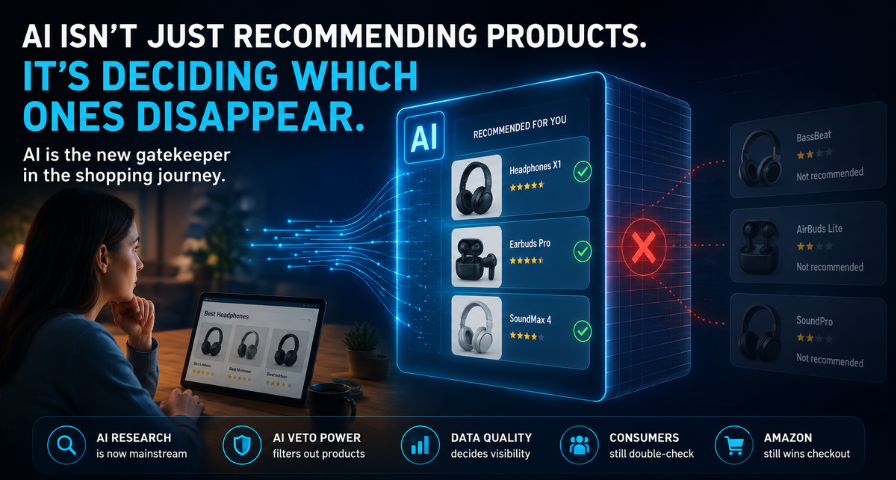
Shopping has always involved a filter, a salesperson, a search engine, a recommendation, or a trusted friend. What's changing is who controls that filter. Artificial intelligence is moving from a shopping assistant to a gatekeeper, influencing not only what consumers discover but also which products they never consider at all.
From Curiosity to Routine
A recent survey conducted by industry players across over a thousand US adults revealed that 63.1% of consumers use AI for their research before purchasing products, compared to 49% last year. Nearly one-third of people use AI shopping assistants at least once a week. This increase is quite important since it means that AI shopping has reached a new stage in its development. For many consumers, using an AI assistant for finding something to purchase has become a standard practice similar to searching for reviews and price comparisons. Most users continue to start the process with a traditional approach, a search engine and an online marketplace being the top options, yet AI-based product discovery has been integrated into both of them via in-built overviews and shopping assistants in apps or separate AI searches initiated by consumers themselves. The starting point remains unchanged. Everything that follows it has changed significantly.
The Dual Role of Recommender and Veto Power
The difference between AI and traditional search ranking lies in the fact that while the latter recommends products, the former does so but also rules them out. More than half of the consumers who use AI for shopping stated that they have dropped the idea of purchasing a product on account of the doubts expressed by the AI assistant. About one in every eight consumers admitted to it being a regular occurrence. On the other hand, close to 40% of such consumers opine that product recommendations by AI are a good fit for them. This perfect blend of being the adviser and gatekeeper is exactly why AI holds sway.
The veto is not arbitrary and does not operate by impression; rather, it mirrors the criteria that people use to request information from the AI prior to purchase. Many people ask the AI for review aggregation, and rather than taking the rating at face value, the AI usually detects patterns, making a product with a 4.2 rating that has consistent criticism of durability a risky purchase. Some customers ask the AI to analyze technical specs; in case the spec sheet of the brand under consideration contains inconsistencies and vague information, the AI would lack credible data, which would prompt it to select an alternative product with better and more reliable info. Finally, there is a smaller group of people who inquire about the safety and effectiveness of ingredients used; in case the manufacturer makes baseless and unverified claims, they are simply ignored by the AI.
Trust Isn't Equal Across Every Category
Not every purchase carries the same emotional or safety weight, and consumers seem to instinctively understand this when deciding how much control to hand over to AI. Comfort with AI-driven purchases is highest for everyday household items, where more than a third of consumers say they'd buy primarily based on an AI recommendation. Electronics aren't far behind. But that comfort drops sharply for pet products, and it nearly disappears for baby products, where fewer than one in ten shoppers are willing to let AI make the call largely on its own. That's roughly a sixfold difference between the most and least trusted categories.
While documentation can be sufficient for winning the comparison in the case of low-risk categories, it is just the first step in the case of higher-risk categories. Reviews, communities, third-party sources, and even the brand need to provide the necessary assurance before consumers will be ready to rely on AI in their decision-making process. At the same time, it should be noted that about 40% of the buyers always conduct their own research irrespective of the recommendation given by the AI.
Every AI Search Is an Open Door for Competitors
The most embarrassing fact regarding brand marketing, however, is that almost a third of all AI shoppers make use of these technologies precisely to find an alternative to the product they're considering purchasing. Even a shopper who has almost decided to make the purchase will still open the doors to competing products. As per the same research, about 79% of all AI shoppers confessed that they switched their brands at one time after following an AI suggestion.
Brand loyalty is apparently not very strong here. In case when AI shows various products side-by-side, the price consideration is used in about 35% of cases, star ratings follow in about 26%, and general brand awareness makes up about 12%. On its own, brand name influences less than 10% of purchase decisions. Every time an AI shopper conducts a comparison of products, the decision becomes like an audition for those products; the better documented product wins regardless of brand reputation or recognition.
The Assistants Themselves Are Multiplying
The places where such comparisons occur are also changing. While the current leader in AI chatbots used for shopping purposes remains the same, another competing chatbot developed by a tech giant made huge strides from last year, significantly reducing the difference between the two. Additionally, there are also increasing numbers of shopping assistants integrated into marketplaces, as well as new players linked to big retail chains who have started to appear in surveys. That means that consumers don’t consolidate their search efforts to one AI searching technology and perform them via multiple sources.
Amazon Still Wins the Checkout, Even When AI Wins the Research
Here's the twist. Even though AI often steers the research phase, one large online marketplace still captures the majority of the actual purchase, roughly half of all AI-researched buys end up completed there. Other retail sites and in-store purchases split most of the remainder, while a brand's own direct-to-consumer website closes out a very small share, well under one in ten. AI-driven research doesn't appear to have displaced the marketplace's advantage at checkout. If anything, the shopping journey suggests the two can work together. A shopper can discover a product through an AI conversation, double-check it on the brand's own site, and still complete the purchase somewhere else entirely.
The websites of brands have not been rendered obsolete yet, however. There is a portion of consumers who use AI and then visit a brand’s website afterwards, not for a transaction but to validate what the AI has provided, to validate certain facts, or even to take a broader look at the product line before finally making a decision about where to purchase from. The practice is particularly rampant among baby and pet items, wherein consumers seek confirmation from the source before taking anything the AI says on face value. In the new funnel, a brand’s website is no longer the site where a purchase takes place.
What This Means Going Forward
The bigger shift isn't that AI is replacing human judgment in shopping. It's that AI is becoming part of the filter through which human judgment happens. Brands are no longer competing only to rank on a search results page. Increasingly, they're competing to be included in the answer.
That makes product information a strategic asset, not just listing content. Brands that maintain clean, detailed, and verifiable data, from specs to ingredient claims to review management, give AI product recommendations more reasons to include them, and give consumers more reasons to trust the recommendation once it's made. Brands that leave gaps in their data are handing ecommerce AI a reason to look elsewhere, often without ever knowing a sale was lost.
As more consumers spread their research across multiple AI shopping assistants and platforms, the real competitive advantage won't come from chasing any single algorithm. It will come from treating product information itself as a trust signal, consistent enough that whichever AI a shopper happens to be using, the answer still points back to you. Visibility may get you considered. Clarity may determine whether you stay in the conversation.
Ready to Grow on Amazon?
Let our experts help you scale your Amazon business with proven strategies.
Get a Free Consultation