AI Hasn't Replaced Amazon SEO, It's Built on Top of It
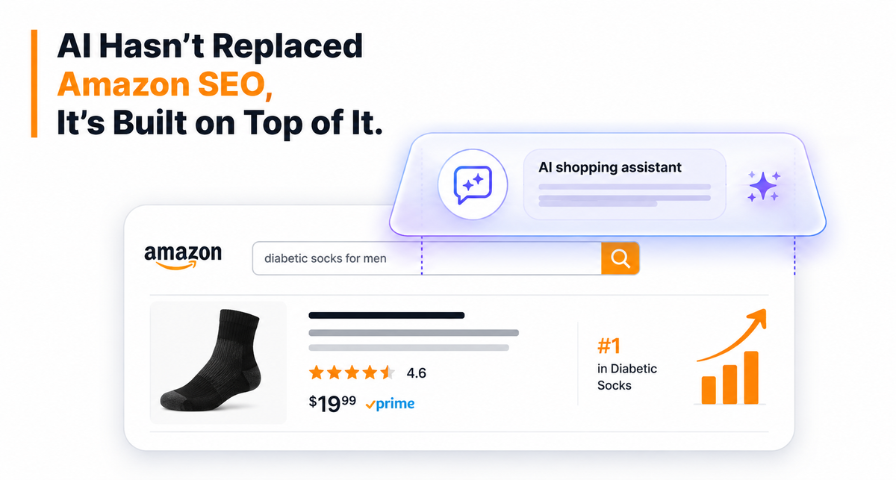
There has been a persistent falsehood floating around the seller community that artificial intelligence has rendered traditional Amazon SEO useless. It hasn't. What has happened is much more interesting and much more valuable for those sellers in the know. The traditional search and relevance capabilities of Amazon still control which products are relevant to the shopper's search term. The difference now is that Amazon's AI-powered shopping experiences, including Alexa for Shopping, are creating another level of interpretation based on that relevancy information, along with additional signals based on shopping context, preferences, and personalization. Since Amazon hasn't released the specifics of its algorithmic interaction at this point, it is worth noting that there may be some guesswork involved here. However, the bottom line is that traditional Amazon SEO hasn't been overtaken, but built upon, and all AI features are additive, not replacements.
This looks to be the beginning of that process as well. Traditional keyword relevancy continues to be optimized by many sellers, creating a great chance for those who have already begun to adapt their listings to conversational AI-based shopping. Here is a list of practical steps you can take right now.
From Keyword Relevance to Answerability
The old way of SEO had one core question Is my product relevant to this keyword? The new way of AI-powered shopping has a slightly different question in mind, closer to "is there enough context in my product description to answer the shopper's real question?" - Call it answerability. A listing might be technically optimized for the right keyword and still fail to answer the shopper's question or the AI assistant representing their interest who is this product made for, which problem does it solve, how does it compare to other options, and will it last long enough? To answer these questions, you do not need to stop optimizing for keywords; you just need to make your listings more detailed and more contextual, making them answerable.
Alexa for Shopping allows consumers to type queries directly into the search bar and even to engage with the search bar in terms of conducting research and comparisons for shopping assistance, not entering a precise string of keywords. A classic keyword search query would read something like "diabetic socks for men." An alternative conversational interpretation of such an interest could be "What men's socks are both comfortable in the cuff and won't bunch up around the ankle?" "The second query has far greater intent. It tells you exactly what the consumer wants, what problem he or she is avoiding, and which attributes are important. Your task is not to replicate the exact wording in your listing. Your task is to provide the right information to answer such a query."
Check How Many Bullet Points Your Category Actually Allows
For years, five bullet points was treated as the ceiling, and a lot of sellers still write to that limit out of habit. That habit is worth revisiting. Amazon has been expanding the amount of structured listing content available in some categories and seller accounts, in certain cases allowing eight to ten bullets rather than five, and this isn't limited to 1P vendors. Third-party sellers are seeing it too, though the exact cap still varies by category. Whether AI shopping systems specifically prioritize the later bullets isn't something Amazon has confirmed publicly, so it's not a claim worth overstating. What is worth acting on is the opportunity itself: where additional bullet fields exist, they shouldn't be treated as optional padding, they should be treated as additional product context that improves answerability. Log into Seller Central today, check how many bullets your category actually allows, and if it's more than five, use the extra space to address real customer questions, clarify use cases, and handle objections you'd otherwise leave unaddressed.
Amazon's separate Modular Titles update reinforces this same shift. Starting July 27, 2026, most product titles outside the media category are capped at 75 characters, including spaces, down from the far longer titles many sellers have relied on for years. To offset that reduction, Amazon introduced a new Item Highlights field with 125 additional characters for details like materials and recommended use cases, content Amazon says is searchable and appears alongside titles in both search results and on product detail pages. Titles left over the limit are gradually rewritten by Amazon's own systems, so sellers who get ahead of the change keep more control over their own wording. The underlying logic is the same as the bullet point situation: less space for keyword-stuffing in the title itself, more structured space elsewhere for the kind of specific, comparison-relevant detail that supports answerability.
Write for Inference, Not Just Keywords
Classical Amazon SEO focused sellers on thinking about keyword density and feature lists. That way of thinking is not necessarily bad, but it is far from being complete in the context of AI-powered search. While a human reader of “easy-to-clean upholstery” is capable of drawing all implied conclusions – it is easy to clean up spills, it saves time, and it can fit homes with children or guests AI can do the same, but you cannot be sure that the AI system makes the inference of all implied connections when they depend on the context known only to you. Better to make these connections yourself feature, benefit, for whom, emotional advantage. Improved variant of upholstery description might be like that: easy-to-clean upholstery that makes easier to clear spills and messes and saves cleaning time and is especially useful for families with children or guests. The same principle is valid for leather with a durable frame it is not only about durability but should be written in such a way that it reflects connection between durability and the everyday value of the product for families with active use of furniture.
Check Whether Your Images Match Your Text
And one part of the puzzle that often gets overlooked is visual and text consistency, which might be worth a brief consideration. In particular, according to Amazon’s research, images associated with the products can be processed through attributes like the neckline of a dress, its color and pattern, and can be associated with textual product information instead of being considered independently from them. How much influence an image-text inconsistency has on product relevance and ranking isn’t disclosed by Amazon publicly; thus, it might not be right to state the exact mechanism by which it happens. Still, common sense suggests that the problem itself makes a lot of sense: for example, when your listing mentions a “V-neck tee," but your primary image shows a crew-neck dress. Even if you never see a direct ranking penalty from it, the contradiction creates a weaker and less reliable product representation, which works against the same answerability you're trying to build everywhere else. Sellers can get a rough sense of what a computer vision system identifies in their images by running their main image through AWS Rekognition, subject to AWS's current pricing and free-tier terms. It's not a direct stand-in for Amazon's internal systems and shouldn't be treated as one, but it's a useful sanity check for catching an obvious mismatch between what your text claims and what your image actually shows.
Build Real Avatars, Not Demographic Shortcuts
"Moms, 25 to 35" is not an avatar. It's a demographic slice, and treating it as a finished customer profile is one of the more common mistakes in Amazon listing optimization today. A real avatar has a story, objections, purchasing patterns, and language specific enough to actually inform copy. Luckily, most of the sellers already have the data available in their account it is just not structured yet. Brand Analytics allows one to get demographics of the audience, like age brackets, gender, income level, and marital status. Market basket analysis will help identify the goods the customers typically buy together, giving valuable hints about their needs and behavior patterns. The Product Opportunity Explorer will uncover some niche angles and objections related to the category. Analysis of search query performance can show which search queries result in impressions, clicks, adding to cart, and purchasing the product from you, allowing you to identify the places where there is demand but weak conversion, which is way more insightful than winning terms. Combining all four and sending this data to an appropriate LLM with a more detailed prompt of a few paragraphs will result in the generation of several named, storied customer avatars, which will be much more useful than any demographic category. These avatars will be used as a basis for inference-based copywriting described above.
The Real Takeaway
This all does not mean giving up on the things that work. Keyword relevance still counts, as do the basics of Amazon SEO. The difference is that AI-enabled shopping is changing the way that information is processed, compared, and personalized, incentivizing thoroughness, specificity, and text-image consistency like nothing else before did. These are the sellers that see the change as an evolution and not as a threat, that make use of the listing space they get, that write for inferences, that verify their images for consistency with their text, and that create customer avatars out of the data they already have, that position themselves for the transition that the majority of the market has not grasped yet. The question to ask yourself before updating your next listing is very simple: if a shopper asked Amazon if your product is suitable for their specific case, would Amazon know enough about your product to answer affirmatively? compared,
Ready to Grow on Amazon?
Let our experts help you scale your Amazon business with proven strategies.
Get a Free Consultation