7 Costly Mistakes Amazon Sellers Make Before Prime Big Deal Days 2026
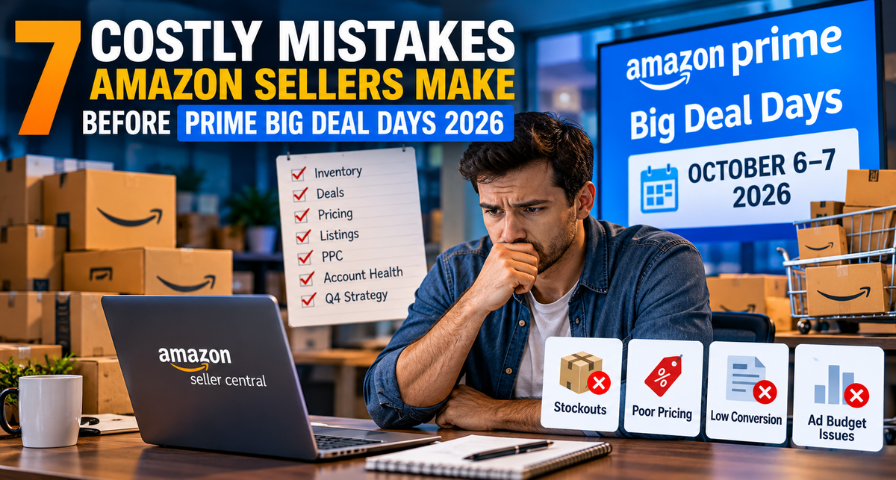
The Traffic Doesn't Create Your Problems, It Reveals Them
Prime Big Deal Days is unlikely to uncover any issues on October 6. It unearths the issues that sellers themselves have made weeks in advance. The stock shortage that brings an end to an otherwise great opportunity for sales at lunchtime, the marketing budget that disappears before the buyers on the East Coast are even out of bed, and the listing that attracts thousands of hits and converts next to nothing all of those start before the event date. In the silence of the planning period.
This year the gap is especially tight and unforgiving. Amazon claims that Prime Day will include more than 35 categories and over 48 hours of exclusive deals for Prime members starting October 6, and also states that Amazon will release new offers three times a day. It means that customer attention comes in waves, and the seller who is not prepared for them gives them to his competition. Now with the event days ahead, here are seven Amazon Prime Day mistakes to check off on your own business and how you can remedy those issues now. Check all the deadlines and eligibility information in Seller Central because the rules change every year.
Mistake One: Guessing at Inventory Instead of Planning It
However, inventory management issues may become the most costly in this regard since it may be the most difficult to correct them. In this case, some merchants will miscalculate, sell out mid-sale, and then see their ranking drop right when the biggest traffic wave of the season is about to come. Other merchants will overcompensate for underestimating their demand, overstock their warehouses, and pay for storage on items they will not sell.
A more accurate forecast should begin with your own data. Calculate how many items were sold per week during your last promotion, subtract the discount you are going to offer, and figure out the average deal multiplier in your category. If a merchant usually sells 40 units of kitchen gadgets per week, it can potentially increase the amount three times, but only if the inventory is sellable and the listings are active. At this point, the issue is not about how many SKUs one has to ship in. It is about whether you will have enough FBA inventory to last the two days or not. Think ahead about what you will do in case your bestselling items run out.
Mistake Two: Waiting Until the Last Minute to Submit Deals
Promotions like Lightning Deals and other promotions available only for Prime members are tied to certain requirements. Amazon usually takes into account factors like star rating, fulfillment type, inventory levels, and price against the background of history. Sellers who start looking into this closer to the end usually find out that their best item is unavailable or that the submission period has ended.
Since the event is so close, check the Seller Central account right now and find out exactly what is scheduled, approved, or declined. If some deal that you planned did not make it into the list, do not think that the event is spoiled. There is a lot that you can still do; coupons, price drops, or bundles will definitely work and will capture the attention of the shoppers browsing the same categories. Choose carefully which items you will offer at reduced prices, the ones that have good margins, positive reviews, and are popular, since they sell once a customer sees that countdown timer on a page.
Mistake Three: Discounting Without Calculating Profit or Watching Competitors
The experience of closing a sale may seem euphoric until you have to review the numbers. The vendor reduces the price by 25%, and the order quantity triples, but after adding up the costs in the end-of-month financial statement, he notices that profits are actually down due to fees, advertising, and product returns. Quantity does not equate to success.
Before you decide on reducing the prices, calculate your costs per unit at this reduced price, including referral fees, costs of fulfillment, warehousing, advertising budgets, and anticipated product returns. There are many cases when a seller consciously decides to reduce his margins for the sake of ranking momentum into the holiday season, which could be justified if there is an upper limit of margins lost.
And then take a look at everything that everyone else is offering. The consumer will be comparing your deal to several others in one place, so look at the prices, coupons, deal badges, number of reviews, images, and availability of your nearest competitors. And also be realistic about the offer itself. Even the best ad, an excellent listing, and sufficient inventory will not help if the cost of your product will significantly exceed similar offers with the same reviews and without any specific difference between them. Will your price, reviews, deal, and uniqueness make a buyer pick you? Don’t try to increase your price to make the offer seem better because it is easy to trace with price trackers.
Mistake Four: Ignoring Listing Conversion Before Traffic Arrives
Traffic comes from preparation, but traffic is also a test. While the traffic is pouring in, far more people than ever before will be checking out your listing and comparing your offering with those from other sellers. But if all that traffic does nothing to lift your conversion rate, then the problem isn't traffic. The problem may lie with your offer, your images, your pricing, your reviews, or your positioning.
What you should do during the next several days is look at your listing as if you were seeing it for the first time. Are the main image and the secondary images clear? Is everything written in your listing answering the customer's actual concerns, like the size of the item, its compatibility, and what exactly is included in the package? Do you have a nicely done A+ Content or Brand Store?
Your reviews need to get examined too. There's a great difference between having hundreds of positive reviews which create social proof, and having just a few mixed reviews, which will make it difficult to close any sales. Read your negative feedback for the last month or so and see if there are issues you could fix in the listing.
Mistake Five: Increasing PPC Without a Clear Strategy
The instinct before a big event is to raise every budget and bid, and it is usually the wrong one. Many sellers report that competition and cost per click rise during major sales, so blanket increases can burn money quickly. A sharper Prime Day PPC strategy treats campaigns differently based on how they perform.
Campaigns that are already profitable and stable deserve protection, so avoid unnecessary changes that disrupt them. Campaigns that regularly run out of budget early in the day while converting well are the best candidates for a controlled increase, since they are being cut off from shoppers who would buy. Campaigns with high clicks and poor conversion should not get more money, because extra spend on a weak offer only makes the loss larger. Your highest-converting search terms need enough budget to stay visible through all three daily deal drops, rather than disappearing in the morning. Finally, review your product targeting and placements, including which competitor ASINs you are targeting, before the event begins, since changing them mid-sale is slow and risky.
The other half of PPC happens after the click. Sending paid traffic to a listing that is low on stock, badly priced, or missing its deal badge is one of the fastest ways to waste a budget, so keep your advertising aligned with your inventory and promotions.
Mistake Six: Overlooking Account Health and Operations
This is the section where you will most probably be able to avoid any major disasters, so consider this your checklist and go through all of these items in the coming week. The increase in order volume adds stress to all the processes in the background, and what seems like a small issue on any normal Tuesday may turn into a big problem with the addition of thousands of extra customers who want to purchase.
First, make sure you have reviewed your inventory and listings. Check for any stranded inventory, suppressed listings, inactive variations, and compliance warnings that might prevent you from selling your product. Make sure your FBA inventory is active, and if you handle your shipments yourself, double-check your handling time estimates for a rush. Take a look at your account health alerts and listing restrictions. Data issues are important as well: wrong dimensions, weights, invalid barcodes, and broken variation links can result in additional fees and listing issues during your busiest period. Lastly, someone should be ready to reply to customer messages promptly, as event days usually generate more of them.
Mistake Seven: Treating Prime Day as Two Days Instead of a Q4 Launchpad
The final mistake is made after the end of the sale. Too many vendors regard Amazon Prime Big Deals Day as a finish line. They are happy with the numbers, go back to regular operations, and do not take anything useful from the experience gained.
In fact, the two days are the beginning of the holiday season, and it should be planned. Think about what should be learned in advance, which products and which discounts have resulted in conversions, how efficient different ad locations were, and whether there was any shortage of inventory. And then use this information for Black Friday and Cyber Monday rather than guessing once again. There is another long-term reward, of course. High-quality products, correct packaging, and brand followers may make some event customers become loyal ones, and this value can often exceed the value of discounted purchases.
What Sellers Should Fix Before October 6
What links these errors is the fact that almost all of them are based on viewing the event as an instant rather than a process. What works better is to weave together your inventory, pricing, listing, ad strategy, and operation into a cohesive whole and to start early enough to make changes as needed.
Time is precious, so focus your efforts on high-impact activities. Start by confirming the accuracy of your inventory and account, as these will prevent any sales at all. Confirm your deal status and competitive pricing, and then optimize your listings and create a strategic PPC strategy for each kind of campaign. Everything else you are unable to verify needs to get done with the time you have left.
On October 6th, the biggest challenge facing you for Prime Day should not be something you could have done on September 30th.
Ready to Grow on Amazon?
Let our experts help you scale your Amazon business with proven strategies.
Get a Free Consultation